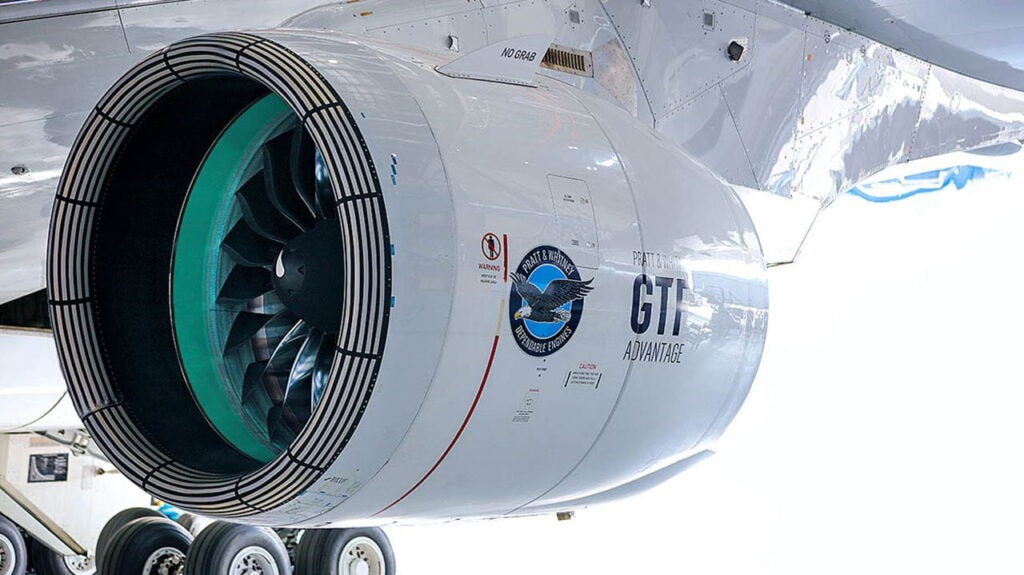
An RTX Pratt & Whitney GTF Advantage engine for the Airbus A321neo aircraft family. (Photo: RTX)
Pratt & Whitney is widening its mandatory inspection program for Geared Turbofan (GTF) engines after finding additional suspect powder-metal components, a move that is set to keep hundreds of Airbus A320neo-family jets on the ground longer than airlines had planned. The latest expansion underscores how the long-running durability issue with the engine is still rippling through fleets well into 2026.
The GTF powerplant was built to change the math of flying. In many ways, it did. Fuel burn dropped, noise footprints shrank, and airlines embraced the promise of a quieter, more efficient single-aisle future.
However, the dominant story right now isn’t performance. It is persistence. A problem first flagged years ago still dictates fleet plans, delivery schedules, and lease rates across the industry.
To be sure, the latest developments are encouraging. Engine removals tied to the powder metal issue are still working through the system, but the number of grounded aircraft has begun to trend down in a measurable way this year.
Reported April 17, Pratt & Whitney said it has secured certification from the European Union Aviation Safety Agency for its upgraded GTF Advantage engine on the Airbus A320neo family, clearing a key hurdle ahead of the engine’s planned entry into service later this year.
The approval builds on prior clearance from the Federal Aviation Administration (FAA) in February 2025, followed by EASA validation in October 2025. With both regulators now aligned, Pratt & Whitney is positioned to begin delivering production engines to airline customers.
The GTF Advantage represents the latest iteration of the company’s geared turbofan architecture and is expected to become the baseline production standard for A320neo family aircraft by the end of the decade.
Pratt & Whitney says the engine delivers 4–8% higher takeoff thrust, supporting increased payload and extended range, while also significantly improving durability, with up to double the time on wing compared with earlier GTF variants.
The certification comes as demand for the GTF platform continues to expand, with more than 2,700 aircraft delivered and over 13,000 engine orders and commitments across all variants.
Persistent Backlog
As a whole for the GTF, shop throughput is rising, parts flow is improving, and more engines are cycling back onto wings. Yet the backlog remains large enough that airlines and lessors are planning around disruption well into the late decade.
At the center is the PW1000G family, the geared engines that power a substantial share of the latest Airbus narrowbodies, the A220, and Embraer’s E2 jets. The architecture is elegant. A reduction gearbox lets the fan spin slower while the core runs faster, extracting better efficiency from both. On paper and in operation, the gains are real.
What went wrong had nothing to do with the concept. The issue traces to contamination in powdered metal used in critical rotating parts. That flaw forced a global inspection campaign that has stretched far longer than early estimates.
Engines have been pulled preemptively, torn down, inspected, and in many cases rebuilt with new components. Each step added time. Each delay compounded the next.
At the peak, hundreds of aircraft were parked at once. Even now, with improvements underway, downtime remains measured in months rather than weeks. Some engines have spent close to a year off-wing, a timeline that has forced airlines to rethink everything from route planning to crew allocation.
The Long Repair Queue Meets a Hot Market
Demand for narrowbody lift has not cooled. If anything, it has strengthened as international travel normalizes and domestic markets stay resilient. That is what makes the current moment so unusual. Airlines want capacity, manufacturers want to deliver it, and financiers are eager to place capital. The constraint is not appetite. It is engines.
Airframers have been unusually direct about the bottleneck. Delivery slots are slipping not only because of production cadence but because engines are not available in sufficient numbers. The priority has shifted toward returning grounded aircraft to service, a rational choice that nonetheless slows the flow of new jets into the market.
Airlines are adapting in real time. Some are extending older aircraft longer than planned. Others are reshuffling fleets, moving engines between airframes to keep the highest-yield routes operating. Schedules are increasingly built around maintenance windows rather than pure demand forecasts. It represents a profound shift in how networks are managed.
Behind the scenes, the repair effort now resembles an industrial surge. Maintenance capacity has been expanded through partnerships and new lines. Digital inspection techniques and additive repair methods are being deployed to shorten turnaround times. The system is getting faster, but it is still catching up to a very large installed base that needs attention.
There are signs the tide is turning. Industry estimates suggest a meaningful number of grounded aircraft will return to service over the course of 2026. That will ease pressure but not eliminate it. The inspection campaign is staged, and waves of engines are still moving through the pipeline.
The financial implications are rippling outward. Aircraft that were once considered interchangeable are now being priced with sharper distinctions. Engine choice has become a first-order variable in valuation models. Lessors are underwriting not just the airframe and the airline, but the probability and duration of future downtime.
For GTF-powered aircraft, that often translates into more conservative assumptions. Longer shop visits mean more time off-lease or under reduced utilization. Maintenance costs are harder to forecast. Lease rate discussions now include detailed conversations about engine exposure and support agreements.
At the same time, scarcity is lifting the broader market. Aircraft with more predictable engine profiles are commanding premiums. Older jets, once on the cusp of retirement, are finding new life as stopgaps. The result is a split market where overall values are supported by tight supply, but individual assets diverge based on their engine risk.
None of this erases what the GTF achieved. The efficiency gains remain compelling, and over the long run they still matter to airlines facing fuel volatility and environmental pressure. But the episode has changed how the industry thinks about innovation. Breakthrough technology now carries a more explicit operational risk premium.
The recovery is real, but it is gradual. Each repaired engine narrows the gap between promise and reality. Until that gap fully closes, the most advanced engine in the narrowbody segment will continue to be defined as much by time on the ground as by performance in the air.
A version of this story originally appeared in sister publication Aircraft Value Intelligence.