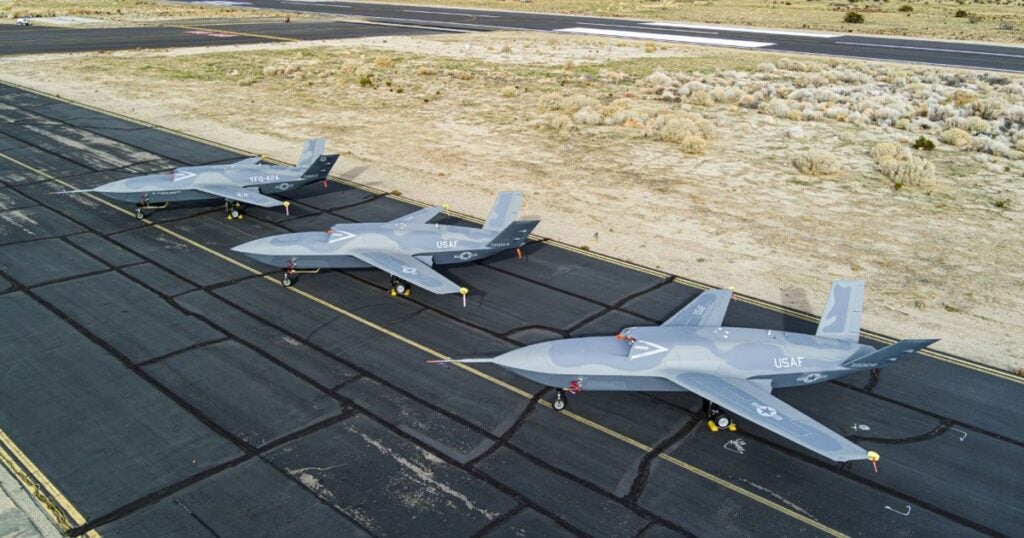
Pictured is a General Atomics’ photo of the company-built YFQ-42A Dark Merlin aircraft.
General Atomics Aeronautical Systems, Inc. (GA-ASI) has paused flight testing of the company’s YFQ-42A Dark Merlin prototype drone for the Air Force’s Collaborative Combat Aircraft program after a mishap about 1 p.m. Pacific time on April 7, the company said.
GA-ASI said that it “is assessing the condition of the aircraft and investigating to establish the root cause of the incident.”
“The aircraft is one of several production-representative YFQ-42A CCAs currently in low-rate initial production for the U.S. Air Force,” the company said. “The jets fly regularly at company-owned facilities as part of their operational test and evaluation program. These flight operations will resume when deemed appropriate.”
The incident reveals a chink in the armor of the argument of Silicon Valley’s “fail fast” philosophy that defense officials say they are adopting. If only a few, relatively costly prototypes are in play, a crash or another type of incident may halt or slow the testing “iteration” demanded by the philosophy.
The Air Force has begun the CCA mission autonomy phase in which RTX‘s [RTX] Collins Aerospace and Shield AI are providing software for the YFQ-42A and the Anduril Industries YFQ-44A Fury prototype, respectively, under the service’s Autonomy Government Reference Architecture approach to adapt new, vendor agnostic software easily into major weapons systems (Defense Daily, Feb. 12).
This year, the Air Force is to choose the YFQ-42A or the YFQ-44A for CCA Increment 1.
The Northrop Grumman YFQ-48A Talon is the third CCA prototype to gain an Air Force designation and may compete for CCA Increment 2–the development of which is to start this year.
In fiscal 2027, the Air Force is requesting nearly $1.4 billion for CCA, a $546 million increase over the $873 million appropriated in fiscal 2026.
A version of this story originally appeared in affiliate publication Defense Daily.
 :
: