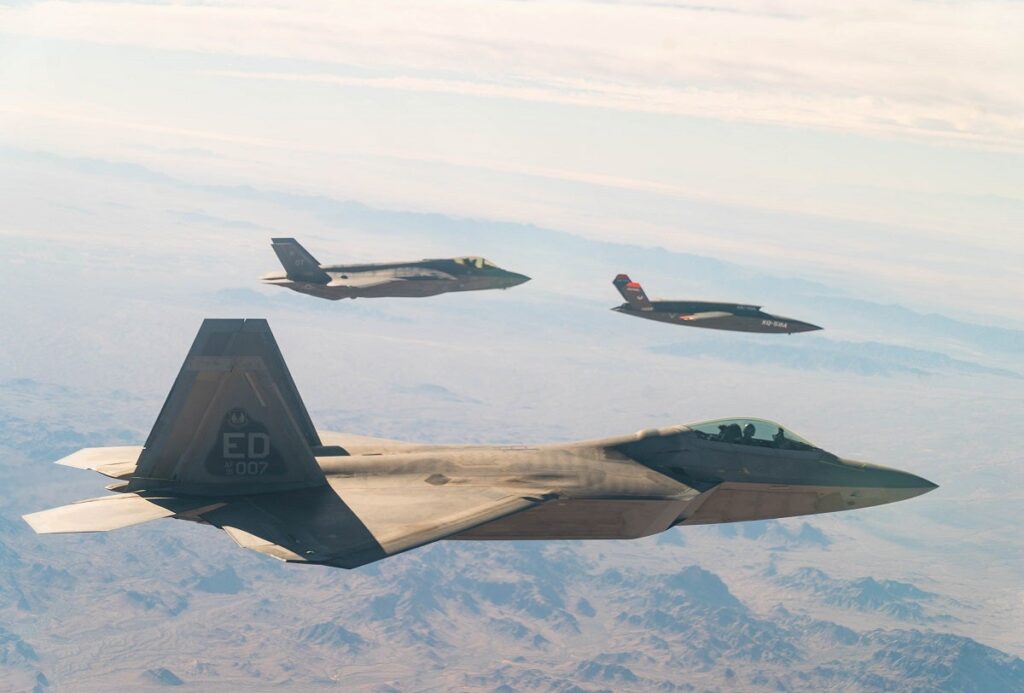
A U.S. Air Force F-22 Raptor and F-35A Lightning II fly in formation with the XQ-58A Valkyrie low-cost unmanned aerial vehicle over the U.S. Army Yuma Proving Ground testing range, Ariz., during a series of tests Dec. 9, 2020. (U.S. Air Force Photo)
Lockheed Martin has begun the “engineering analysis” around adding sixth-generation features to the company’s fifth-generation fighters based on development work it did on the losing bid for the Air Force’s Next-Generation Air Dominance (NGAD) fighter won by Boeing earlier this year, Jim Taiclet, the company’s chief, said on Tuesday.
The goal of the analysis is to “enhance the relevance and capability” of the F-35 and F-22 with “advanced and expanded weapons compatibility, improved data links, autonomous drone wingman integration, superior sensors and the latest electronic warfare capabilities,” Taiclet said in his scripted remarks during Lockheed Martin’s third quarter earnings call.
Later in the call, Taiclet said classified research and development on NGAD at the company’s Skunk Works unit also included work on stealth, propulsion, inlet designs, coatings, “which we can actually backward integrate into F-35 and F-22 and are doing so.”
After losing NGAD to Boeing last spring, Taiclet said in April that his company would leverage the “technology and knowledge” from the program and transfer them to the F-35 and F-22 to get 80 percent of the capabilities of the sixth-generation aircraft at half the cost.
The engineering analysis on the F-35 and F-22 comes at the direction of Taiclet, he said. The upgrade effort is “to provide the greatest aggregate level of air superiority capability at the most efficient cost and the fasted deployment,” he added. “This is a total best value approach that we think will be best for the department. To that end, we are working closely with our customers to align our internal investments with their most important mission priorities for the F-35.”
Lockheed Martin has delivered more than 1,200 F-35s domestically and abroad, Taiclet said.
Boeing’s NGAD effort has been renamed F-47 after it won the engineering and manufacturing development contract.
The targeted internal investments into the F-35 and F-22 aircraft are part of a new approach Lockheed Martin is taking toward the use of its internal research and development spending, Taiclet said. Rather than just portion out the R&D investments across the business units and leave it to them to sort out their priorities, some of this internal spending is focused on corporate R&D efforts, he said.
A version of this story originally appeared in affiliate publication Defense Daily.
 :
: