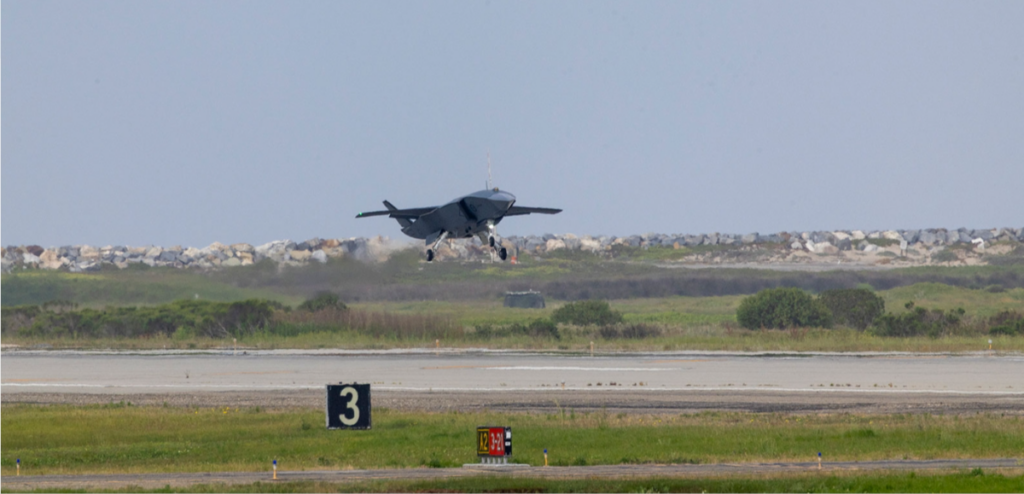
An MQ-28 Ghost Bat, which Boeing said recently made three operational flights over the Pacific Ocean. (Photo: U.S. Navy)
Boeing said on June 1 that it has validated the low Radar Cross Section (RCS) of the company’s MQ-28 Ghost Bat drone.
“The MQ-28’s RCS reduces the range that enemy radars can detect and engage an MQ-28, enhancing the platform’s survivability in contested environments,” according to Boeing. “The success of the RCS testing confirms the effectiveness of the MQ-28’s design, production and material choices in minimizing radar detection.”
In March, Boeing said that it is teaming with Rheinmetall to offer Germany a fielding of Ghost Bat by 2029 as a collaborative combat aircraft (CCA).
Boeing said that there have been more than 150 flights of the MQ-28, which began development in 2017 under Boeing Australia and took to the air for the first time in 2021.
For the U.S. Air Force’s CCA Increment 1, the General Atomics YFQ-42A Dark Merlin is competing against the Anduril Industries YFQ-44A Fury, and the service this year is to pick a winner and begin Increment 2.
“The MQ-28 Ghost Bat is designed to complement existing crewed aircraft by performing a variety of roles, including surveillance, electronic warfare, and force multiplication, all while maintaining a low radar profile,” Boeing said on June 1. “This [low RCS] milestone further demonstrates the platform’s maturity, survivability, and ability to deliver cost-effective advanced capability for modern air combat operations.”
Boeing said that the MQ-28 has fired an Advanced Medium-Range Air-to-Air Missile against a target drone, teamed with other Ghost Bats and with an E-7A Wedgetail airborne early warning aircraft and an F/A-18F Super Hornet, and has conducted three “international” test flights over the Pacific Ocean while using U.S. Naval Base Ventura County in Point Mugu, Calif.
A version of this story originally appeared in sister publication Defense Daily.
 :
: