Editor’s Note: This week, John Persinos interviewed Nick Lappos, co-chair of the American Institute of Aeronautics and Astronautics (AIAA) Committee on Certification of Advanced Airmobile Aircraft. Nick is an Aerospace Engineering graduate of Georgia Tech and holds over 30 patents and three helicopter world speed records. He was appointed to the National Academy of Engineering (NAE) and was Chairman of the NAE Committee on Advanced Air Mobility.
Nick also served as Sikorsky Aircraft’s Chief Research and Development test pilot, logging more than 8,000 hours of flight time in over 70 different types of helicopters. He is a decorated veteran of the Vietnam war, where he flew Cobra helicopters. The following is a transcript condensed for concision, with questions in bold.
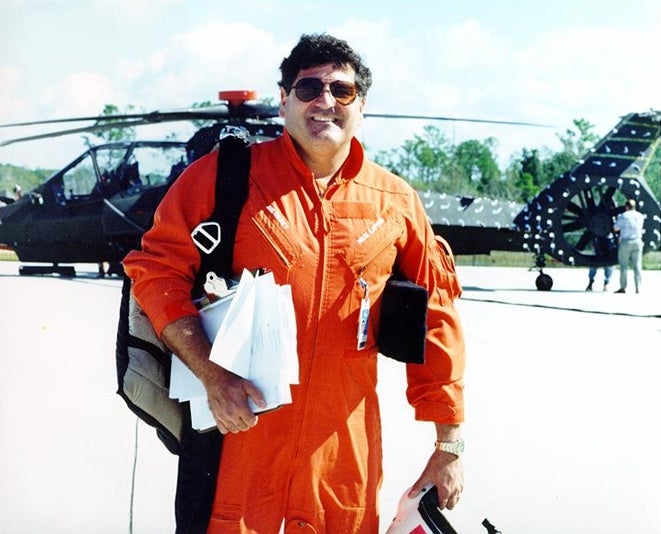
Nick Lappos, co-chair of the American Institute of Aeronautics and Astronautics (AIAA) Committee on Certification of Advanced Airmobile Aircraft.
What new aerospace technologies excite you right now?
I’m not sure there has ever been a time when aerospace wasn’t exciting, but right now the field feels especially vibrant. The range of technologies at our fingertips is remarkable, particularly digital design and manufacturing tools that reduce lead times and enable more versatile and capable machines.
Concepts like additive manufacturing provide unprecedented freedom to design and build faster, more accurately, and at lower cost.
I think this will manifest itself in several important ways. We’ll see many more types of aircraft tailored to specific missions, especially in smaller market segments that are currently uneconomical due to high development costs and long timelines.
As build economics improve, designers can create more precise solutions with better performance and cost alignment for each mission.
How has digitization changed barriers to entry?
We’re in the middle of a manufacturing and design revolution. Up to now, entrenched companies with experienced engineering teams and mature manufacturing systems were nearly impossible to compete with—think Tucker versus the Big Three automakers in the 1940s. Today, digital design, manufacturing, and inventory tools allow new entrants to become competitive much more quickly.
There are few better examples than SpaceX. In just a few years, the company produced world-class, highly efficient launch systems, driven by accessible design tools, rapid iteration, and bold, well-funded leadership.
We see similar patterns in electric vehicle startups. Companies like Tesla and BYD (Build Your Dreams) now challenge established automakers with capable, attractive, and relatively affordable vehicles developed in a fraction of the traditional time. This should help many countries to develop world-class products and challenge the traditional First-World manufacturers.
Modern digital tools allow strong engineering teams to develop products in months that once took years. The likely outcome is more innovation and better transportation systems, much like how Silicon Valley transformed consumer electronics.
How big a deal is electric vertical take-off and landing (eVTOL) aircraft technology?
The eVTOL space is exciting and has received a great deal of attention, but it’s important to understand what’s really changing.
Electric propulsion fundamentally reshapes aircraft powertrains. Traditional helicopters rely on complex transmissions and fuel-burning engines with hundreds of precision components. Electric systems eliminate much of that complexity.
Electric motors produce high torque even at zero RPM, often allowing direct-drive architectures with no engines or transmissions. This reduces part count, cost, development time, certification effort, and maintenance requirements, while increasing reliability and component life.
Electrification means simplicity. Electric aircraft and vehicles may have roughly 30% of the mechanical complexity of combustion-based systems. That reduction cascades into lower costs across design, manufacturing, operation, and ownership. The full impact will emerge as pricing continues to fall. BYD may be an early indicator of that shift.
Autonomous electric taxis, air and ground, could become extremely compelling if their operating costs drop far enough, potentially to half the per-mile cost of human-operated services.
However, the long-term impact of eVTOL goes far beyond passenger air taxis. While air taxis will play a role, the largest eVTOL market is likely autonomous cargo, i.e. small, lightweight, low-cost aircraft delivering packages in both urban and rural environments.
The real advantage of eVTOL is access to true three-dimensional transportation. By lifting off the ground, these vehicles avoid congestion and can travel directly from point A to point B.
Every day on Manhattan island ten thousand box trucks bring “Rapid Express” packages to people, with a human driver and an average speed of perhaps 10 miles per hour. Meanwhile, a small eVTOL vehicle weighing 100 kg and carrying a 10–20 kg payload could potentially operate at just a few cents per mile and move from warehouse to address at 50 miles per hour. Is there any real competition between the two?
These small eVTOL systems could deliver medicine, consumer goods, and critical supplies. It’s no surprise that companies like Amazon, FedEx, Walmart and DoorDash are investing heavily in this space.
The country that deploys these systems effectively could gain a major economic advantage through reduced logistics friction and lower delivery costs. The most telling realization is that transportation is actually an integral part of the merchandising flow.
This sector may ultimately surpass traditional aviation in revenue. The airline industry generates on the order of hundreds of billions annually, but global package delivery already rivals that and continues to grow rapidly.
Public acceptance will depend on safety, noise, reliability, and convenience. If the industry delivers on those factors, adoption could be swift.
Imagine a scenario where a doctor prescribes medication at 2:00 a.m., and it arrives at your door within 30 minutes, or a fire department that can have firemen at your door in less than 3 minutes. That kind of capability would demonstrate the public good and drive strong demand. If instead eVTOL is used to carry billionaires to the opera over the heads of the public, it could be DOA.
One important aspect of this future eVTOL world is the question of safe air traffic control. With thousands of vehicles flying over a city, sorting out traffic needs, preventing potential collisions, and assuring the priority of human and emergency operations becomes a vast chore.
It is probable that new air traffic control network technology will be needed, where each air vehicle, integrated into a network, reports its position identity and intentions to a system that can aid the traffic controllers in their tasks.
Where is aviation heading?
Aviation will continue to expand globally as developing regions build infrastructure similar to that of North America and Europe. As incomes rise, demand for air travel in Africa, Asia, and South America will grow significantly, leading to a much larger global airline network.
At the same time, the eVTOL cargo ecosystem will spread worldwide. While urban areas will likely see early adoption, rural regions may benefit just as much. For example, delivering a low-cost package to a remote location is often inefficient using traditional trucking.
An eVTOL system could complete that same delivery faster and more economically. I live in Utah, about 45 miles from a small town, where deliveries can take two extra days. With eVTOL logistics, that delay could shrink dramatically, as the per mile cost of the eVTOL is a fraction of the cost of a box truck and driver.
Nick, you’re both a pilot and an engineer. Your reputation in the industry is formidable. I remember, as a reporter, watching you test fly military helicopters way back in the 1990s. What, in your view, are the truly game-changing avionics and flight-control technologies currently under development?
From a pilot and engineering perspective, the most transformative changes may come from flight control systems rather than traditional avionics alone.
Historically, aircraft have relied on control interfaces not far removed from early designs—essentially control sticks and pedals—with pilots responsible for managing attitude, speed, altitude, and heading. Autopilots simply automate those same inputs.
Fly-by-wire systems change that paradigm entirely. They don’t just reduce mechanical complexity; they allow the aircraft’s behavior to be defined by software. Control laws can transform how an aircraft responds, enabling precise, stable, and intuitive operation.
It’s possible to use computer laws to make an aircraft drive like a car and be so simple to operate that the pilot could have the equivalence of a driver’s license. Complex low-altitude maneuvers could be performed with high precision, even by non-pilots.
As these systems evolve, combined with autonomy and obstruction sensors, flying may become far simpler. A future pilot might simply input a destination by pressing a button labeled “Cleveland”, and let the aircraft handle navigation, flight, and contingencies.
On the avionics side, technologies like augmented-reality see-through vision systems can overlay critical flight information directly into the pilot’s field of view. These systems can create a synthetic visual environment, allowing safe operation in poor visibility or at night, and significantly reducing controlled flight into terrain (CFIT) risks.
Together, advanced control laws, autonomy, and enhanced vision systems are reshaping both safety and usability. We’re beginning to merge aerospace with computing and even gaming technologies in ways that fundamentally change how aircraft are flown.
Thanks for your time.
John Persinos is the editor-in-chief of Aircraft Value Intelligence.
 :
: