Global Aviation Round-Up from Aircraft Value Intelligence (AVN)
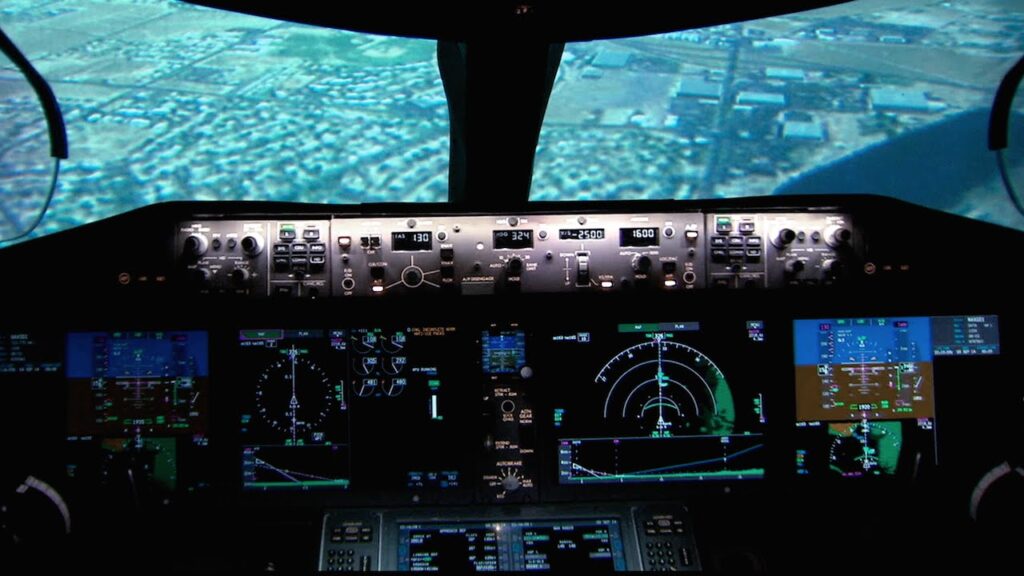
Boeing flight deck with glass digital flight deck changes. (Image: Boeing)
If connectivity is transforming aircraft into data platforms, then avionics are transforming them into intelligent systems. Next-generation avionics are now one of the most powerful drivers of aircraft value and lease rate differentiation across global fleets.
Modern avionics systems extend far beyond traditional navigation and flight control. Today’s flight decks integrate predictive flight management systems, real-time situational awareness tools, synthetic vision, and early-stage artificial intelligence that assists pilots with decision-making. These systems are becoming central to how aircraft are priced in leasing markets.
Aircraft manufacturers Airbus and Boeing have both accelerated avionics modernization across their product lines. The A350 and A320neo families feature highly integrated digital cockpits, while Boeing’s 787 Dreamliner incorporates a fully networked avionics architecture designed to support continuous software evolution.
Embraer’s E2 family and Bombardier’s Global business jets are also increasingly used as benchmarks for advanced avionics integration in regional and business aviation.
The impact on lease rates is material. Aircraft with advanced avionics suites are typically more attractive to operators because they reduce workload, improve fuel efficiency, and enhance operational reliability. That translates into stronger demand and firmer lease rate environments.
AI to the Fore
One of the most significant trends is the rise of AI-assisted flight management systems. These systems optimize routes dynamically, taking into account weather, air traffic congestion, and fuel efficiency targets. By reducing fuel burn and improving punctuality, they directly affect airline economics. Lessors are responding by embedding these efficiencies into their valuation models.
Another key development is the growing role of avionics in predictive maintenance. Modern flight decks continuously monitor system health and communicate anomalies to ground systems. This reduces unexpected failures and improves dispatch reliability, both of which are critical inputs in determining aircraft residual value.
Regulatory pressure is also reinforcing the importance of avionics upgrades. Air traffic management modernization programs around the world are requiring more precise navigation capabilities, including performance-based navigation and advanced datalink systems. Aircraft that are already compliant with these evolving standards are inherently more valuable.
Retrofitting older aircraft remains a major challenge. While upgrades are possible, they are often expensive and technically complex. This creates a widening gap between legacy fleets and new-generation aircraft equipped with fully integrated avionics systems. As a result, newer aircraft tend to retain stronger lease values for longer periods.
For lessors, avionics capability is increasingly treated as a capital asset driver rather than a technical specification. It directly influences how long an aircraft can remain competitive in the global fleet.
Avionics are no longer just about flying the aircraft. They are about defining its economic life.
This article originally appeared in Aircraft Value Intelligence.
John Persinos is the editor-in-chief of Aircraft Value Intelligence.
 :
: