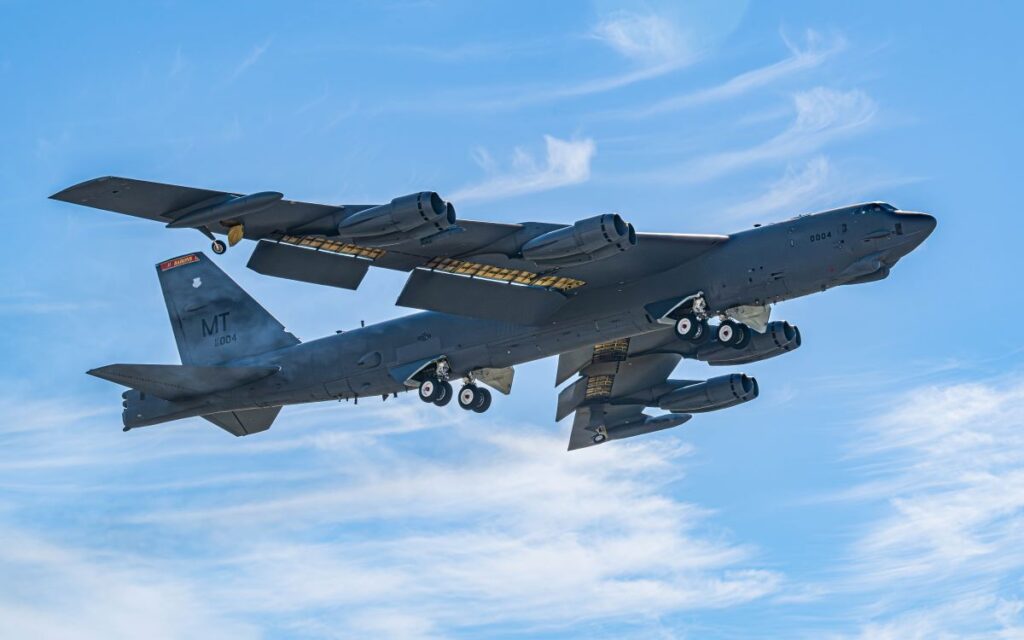
Pictured is a B-52H Stratofortress assigned to the 23rd Expeditionary Bomb Squadron taking off in support of Bomber Task Force Europe at Morón Air Base, Spain on May 27 (U.S. Air Force Photo)
The U.S. Air Force Commercial Engine Replacement Program for the Boeing B-52J recently passed a Critical Design Review (CDR), according to the service.
The passage of CDR allows Boeing’s San Antonio, Texas, plant to modify two B-52Hs later this year to carry new F130 engines by Rolls-Royce.
“Following this initial work, the two modified B-52J test aircraft will undergo extensive testing at Edwards AFB, Calif. to validate the new systems,” the Air Force said. “Once testing is complete, the program will move toward modifying the remainder of the B-52H fleet.”
The more powerful F130s are to replace the B-52H’s eight Pratt & Whitney TF33-PW-103s. Under the Radar Modernization Program (RMP) for the B-52H, an active electronically scanned array radar based on RTX’s APG-79 is to replace the bomber’s Northrop Grumman [NOC] APQ-166. After the CERP and RMP upgrades, the B-52Hs become B-52Js.
In February, Rolls-Royce said that it had completed altitude and operability testing for the F130 at the Air Force Arnold Engineering Development Complex in Tullahoma, Tenn.
The Air Force is to use the two test aircraft to begin developmental flight testing in fiscal 2029 and to finish the initial operational test and evaluation (IOT&E) phase in fiscal 2032. The Air Force is to award low-rate initial production (LRIP) contracts to modify 51 of the 74 B-52Hs before CERP IOT&E ends, and the service is to award full-rate CERP production contracts in fiscal 2033 and 2034 for the remaining 23 bombers.
The Pentagon Directorate of Operational Testing and Evaluation (DOT&E) has said that “integration of new engines” on older aircraft is a major challenge and will require extensive flight testing to evaluate safety and performance.
The Air Force’s CERP acquisition strategy “implements a highly concurrent flight test and production program, awarding LRIP contracts for 69 percent of fleet aircraft prior to IOT&E,” according to DOT&E’s fiscal 2025 annual report. “Previous aircraft development programs with highly concurrent flight test and production schedules of this kind have frequently incurred significant cost increases and schedule delays driven by deficiency discoveries.”
Section 4231 of Title 10 provides that an LRIP buy for a Major Defense Acquisition Program cannot exceed 10 percent of the total production quantity without a waiver.
“The Air Force’s rationale for establishing 69 percent of fleet [B-52] aircraft as the minimum [CERP] LRIP quantity necessary for these limited purposes is based on a 2017 business case analysis that projected significant cost savings from procurement of a commercial engine replacement in fewer and larger lots with installation schedules aligned with existing B‑52 periodic depot maintenance schedules,” DOT&E said.
A version of this story originally appeared in sister publication Defense Daily.
 :
: