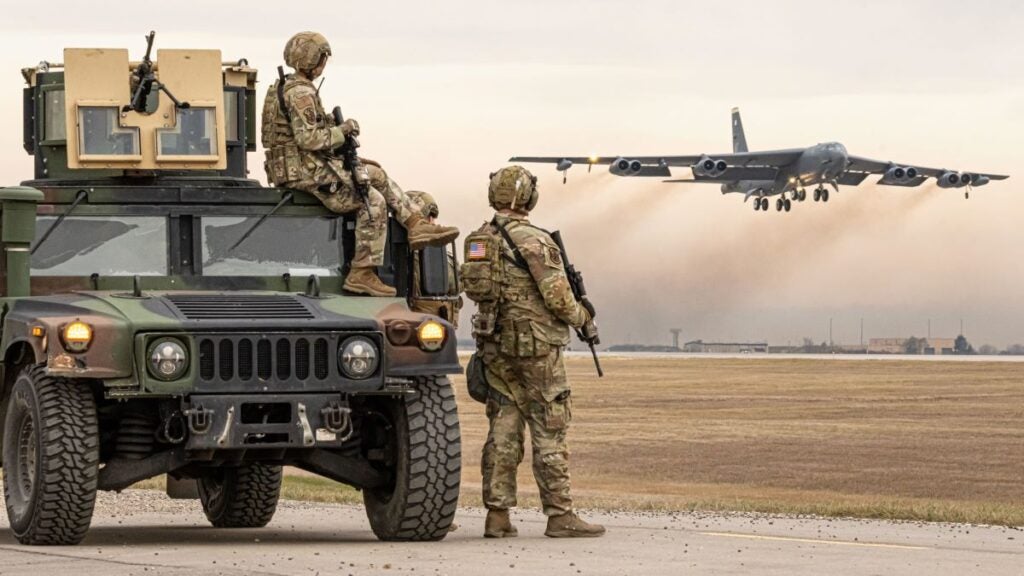
Pictured is a U.S. Air Force photo of personnel with the 5th Security Forces Squadron at Minot AFB, N.D. on Oct. 26, 2025, as they watch a B-52H bomber take off during the Global Thunder 26 exercise.
As the U.S. Air Force prepares to modify two B-52H bombers later this year for the Commercial Engine Replacement Program (CERP), the bomber directorate’s contracting office at Tinker AFB, Okla., is to meet with contractors interested in supplying support equipment for the installation of the new Rolls-Royce F130 engines.
On May 12 and 13 the Air Force planned to hold industry days at Rose State College in Midwest City, Okla., to discuss A and B kit production and Integrated Change Set (ISC) support for CERP.
Envisioned tasks include “production kits and related support work such as program and manufacturing management, integrated logistics support, field service representative support, travel, spare parts, peculiar support equipment, production tooling, common support equipment, data, and over-and-above labor and materials for multiple kit groups and period options,” according to the Air Force.
The two discussion days are “an opportunity for industry to ask questions, provide feedback on the draft statement of work, and for the government to better understand the current market capabilities [for the kits and ISC],” the service said.
The Air Force said its approval of B-52 CERP in a recent Critical Design Review allows for the modification of the two B-52Hs with the F130 this year.
The more powerful F130 engines are to replace the B-52H’s eight Pratt & Whitney TF33-PW-103s. Under the Radar Modernization Program (RMP) for the B-52H, an active electronically scanned array radar based on RTX’s APG-79 is to replace the bomber’s Northrop Grumman APQ-166. After the CERP and RMP upgrades, the B-52Hs are to become B-52Js.
New Bomber or More B-52 Weapons Capacity?
The last B-52H fielded in October 1962, and, while the Air Force looks to field 100 or more Northrop Grumman B-21 stealth bombers to replace the service’s B-1s and B-2s, the future path for the B-52 is still under consideration.
The Air Force requests $50 million in fiscal 2027 to integrate the latest versions of the family of AGM-158 Joint Air-to-Surface Standoff Missiles (JASSM) by Lockheed Martin on the B-52. In addition, the service requests $30 million in research and development to replace the bomber’s “structurally limited, 1960s-era pylon” with the Advanced Wing Weapon Pylon (AWWP).
“This is the key that unlocks all future heavy-weight weapon capabilities for the B-52,” the Air Force said in its fiscal 2027 budget request. “Pre-acquisition activities [are] to structure the integration of a GFE [government-furnished equipment weapon onto the AWWP.”
The latter effort “will design, develop, integrate and field a new pylon onto the B-52 to take advantage of increased mass provided to the battlefield,” the Air Force said. “Specifically, the current pylons carry limited weapons (i.e. 6x JASSM each) at limited weight, where AWWP will increase carriage capacity in both weight and amount (i.e. 8x JASSM each).”
In fiscal 2027, the Air Force also requests $1 million to kick off a “new heavy bomber analysis of alternatives” to examine a possible replacement for the fleet of 76 B-52Hs. The $1 million in funding would start “planning activities to develop key performance parameters, key system attributes, and additional performance attributes for a follow-on heavy bomber in the USAF.”
A version of this story originally appeared in sister publication Defense Daily.
 :
: