Global Aviation Round-Up from Aircraft Value Intelligence (AVN)
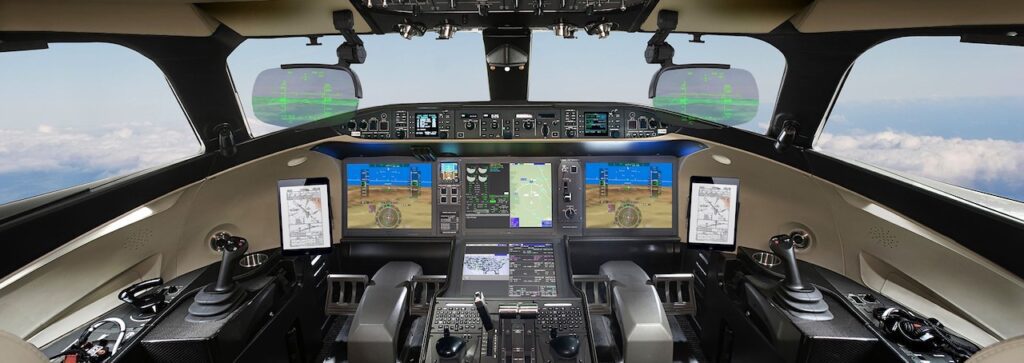
Bombardier will feature the Vision flight deck in its newly launched Global 8000 business jet. (Photo, courtesy of Bombardier.)
From heads-up displays to AI-powered predictive maintenance, avionics technology is evolving into a cutting-edge field that’s as advanced (or more so) than any other technological realm. As a business, avionics is booming around the world.
Those are the conclusions to be drawn from a new report this month from Business Research Insights (BRI).
The report, updated May 7 by BRI, states that the global commercial aerospace avionics market is on track to grow from about $8.75 billion in 2026 to roughly $11.2 billion by 2035. At first blush, that growth seems modest. But look closer and you’ll see that the major airlines are reconfiguring cockpits around automation, connectivity, predictive analytics, artificial intelligence, and increasingly digital flight operations.
Nearly 30,000 commercial aircraft were operating globally last year, and nearly three-quarters already featured advanced avionics suites that were infused with the latest technology. Glass cockpits are now the norm on newly delivered aircraft. What’s more, across the medium-haul fleet (e.g., the B737, A321neo, and E-190), fly-by-wire has become a fixture.
Satellite navigation systems are now common across much of the world’s aircraft fleet. At the same time, airlines are increasingly turning to predictive maintenance software that spots mechanical issues before they cause expensive delays.
Maintenance, Repair and Overhaul (MRO) shops continue to report huge backlogs, which is gumming up the works for OEMs and end users alike. Predictive software is helping loosen the logjam, especially amid a chronic shortage of avionics technicians.
As the BRI report states, on a year-over-year basis from 2024 to 2025: “AI-enabled avionics analytics adoption increased by 43%, cloud-based flight management systems expanded by 38%, touchscreen cockpit display integration crossed 61%, and autonomous communication technologies achieved 29% penetration in commercial aircraft systems.”
Favorable Economics
You don’t need a degree in economics to figure out why airlines are pouring huge investments into avionics tech. Ultra-modern avionics save time and money. The latest systems improve fuel efficiency, help pilots fly more efficient routes, cut maintenance downtime, and make it easier to navigate increasingly congested airspace.
Airlines operate on razor thin margins, a precarious economic condition that’s being exacerbated by the protracted Iran war. But more capable avionics exert a tangible difference on the bottom line.
Budget airlines, especially across Asia, are burgeoning. They’re upgrading their fleets with more advanced digital cockpits, better communications systems, and newer onboard technology.
Narrowbody jets are still driving most of the demand for new avionics, largely because regional and domestic air travel keeps growing around the world. Next-gen jets such as the A32o and B737 MAX families are among the most popular planes in the world; Airbus and Boeing can’t make them fast enough. These planes also are outfitted with the very latest avionics, which only enhances their appeal.
Display systems make up the biggest segment of the avionics market as airlines race to modernize their cockpits. More carriers are replacing old-school analog gauges with digital screens and touchscreen controls.
The newer systems give often-harried pilots more information at a glance. They also cut down on workload and make it easier to manage increasingly crowded airspace. These are crucial advantages, as pilots continue to grapple with the worsening air traffic control crisis.
The Ascendancy of AI
Artificial intelligence is becoming a bigger part of modern aviation systems. Airlines are using AI-driven diagnostics and predictive maintenance software to monitor aircraft performance in real time. The idea is straightforward. Spot mechanical issues before they cause delays, cancellations, or costly repairs.
Cloud-connected avionics systems are spreading quickly as well. They give airlines faster access to flight records, maintenance updates, and operational data across entire fleets.
But the technology push is creating new problems, too. Certification delays continue to slow deployments as regulators try to keep up with fast-changing systems. Airlines are also dealing with higher installation costs, software testing hurdles, and rising cybersecurity risks as aircraft become more connected.
Rising Cyber Risks
Cybersecurity has become a major concern as avionics systems grow more connected and dependent on digital networks. Airlines and aerospace companies are pouring money into protecting flight systems and communications platforms from cyberattacks. Integrating equipment from different vendors can also create headaches, especially when airlines try to upgrade older aircraft with newer technology.
The report also notes that North America still leads the global avionics market. A huge commercial aviation industry and aggressive fleet upgrade programs continue to drive demand across the region.
The BRI report states: “North America held nearly 37% market share due to high aircraft modernization activity, while Europe accounted for 26%, Asia-Pacific reached 24%, and Middle East airline avionics deployment exceeded 13% in premium fleets.”
U.S. airlines have been especially aggressive in upgrading cockpit communications and navigation systems, while the FAA continues processing thousands of avionics-related certifications tied to new technologies.
Europe remains a major player as well, driven by strict aviation regulations and ongoing sustainability initiatives. Airlines there are investing in lighter, more energy-efficient avionics systems aimed at reducing fuel burn and supporting broader environmental goals.
Emerging Market Growth
Meanwhile, Asia-Pacific represents the industry’s most important long-term growth story. Increasingly affluent middle-class citizens in this region are clamoring for “the good life” and that includes tourism.
Air travel growth in India, Southeast Asia, the Middle East, and parts of Africa continues to outpace mature markets. That geographic shift favors versatile narrowbody aircraft that carry the latest avionics.
Leasing demand in these regions is intense, driving stronger pricing for aircraft optimized for high-cycle growth environments.
Rapid airline expansion across China, India, and Southeast Asia is fueling enormous demand for new aircraft and avionics upgrades. Regional carriers are investing heavily in predictive maintenance systems, satellite navigation, and digital cockpit technologies as passenger traffic continues climbing.
John Persinos is the editor-in-chief of Aircraft Value Intelligence
 :
: