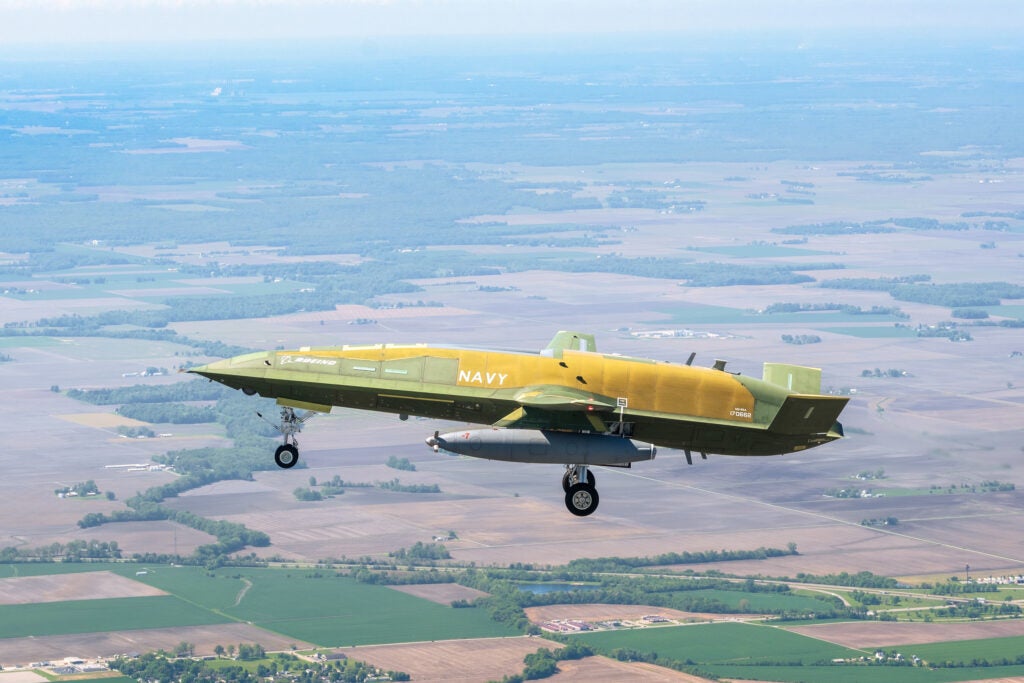
The Navy’s MQ-25A Stingray first carrier-based unmanned tanker takes its first flight on April 25, 2026 at Boeing’s facility at MidAmerica Airport in Mascoutah, Ill. The MQ-25 is the Navy’s first operational carrier-based unmanned aircraft. (Photo: Boeing)
The first Boeing MQ-25A Stingray carrier-based unmanned tanker aircraft conducted its first flight test on April 25, a year later than previously planned, the Navy and Boeing revealed on April 27.
The test occurred on the morning of April 25 at Boeing’s facility at the MidAmerica Airport in Mascoutah, Ill., where the MQ-25A flew for about two hours up to an altitude of 10,000 feet.
Naval Air Systems Command (NAVAIR) noted that during the flight, Navy and Boeing Air Vehicle Pilots controlled the aircraft from the Unmanned Carrier Aviation Mission Control System MD-5 ground control station (GCS), which includes the Lockheed Martin MDCX software system.
In 2020 the Navy selected MDCX for the ground control component for MQ-25 that was developed by the Lockheed Martin’s Skunk Works division.
MQ-25A is powered by a single Rolls-Royce AE 3007N engine. The company said it plans to deliver four more engines to Boeing in 2026 to support production spares and noted the AE 3007 engine is also used for the Air Force’s Northrop Grumman RQ-4 Global Hawk and Navy MQ-4C Triton unmanned aircraft.
For the flight, the pilots conducted a series of maneuvers and tests that the Navy said successfully validated its basic flight controls, engine performance and handling characteristics. Boeing noted this demonstrated the Stingray’s ability to autonomously taxi, take off, fly, land and respond to commands from the GCS by sending it commands and monitoring performance.
The company added that once the aircraft was airborne, the Stingray conducted a predetermined mission plan to validate the flight controls, navigation and integration with the GCS.
The Navy awarded Boeing the original $805 million engineering and manufacturing development (EMD) contract in 2018 to design, develop, build, test and verify the first four unmanned tankers.
The service plans to procure 76 MQ-25s, including four EMD models and five system demonstration test articles to replace the F/A-18EF Super Hornets performing tanking duties. Each MQ-25 is powered by a single Rolls-Royce AE 3007N engine.
The new aircraft is primarily designed to free up the Super Hornets for strike and training missions but also increase Navy familiarity with carrier-based unmanned aircraft and manned-unmanned teaming in advance of the sixth-generation F/A-XX program with its planned collaborative combat aircraft.
“Achieving this first flight underscores the strong partnership between the Navy and our industry partners. The MQ-25A is not just an aircraft; it’s the first step in integrating unmanned aerial refueling onto the carrier deck, directly enabling our manned fighters to fly further and faster. This capability is vital to the future of naval aviation,” Rear Adm. Tony Rossi, who oversees the Program Executive Office for Unmanned Aviation and Strike Weapons, said in a statement.
Capt. Daniel Fucito, Unmanned Carrier Aviation program manager (PMA-268), added that this test flight initiates a “rigorous flight test program, which will focus on expanding the aircraft’s performance envelope and verifying all mission systems.”
The Navy said the MQ-25A team will now continue ground control station integration, expand the flight envelope and verify performance parameters at the MidAmerica facility.
In a statement to Defense Daily, Fucito said following the initial EMD 3 flights at MidAmerica, the aircraft will fly to Naval Air Station Patuxent River, Md., this summer “to conduct additional testing prior to launch and recovery testing at Joint Base Maguire-Dix-Lakehurst, New Jersey, this fall.”
Following those events, the Navy plans for the first MQ-25A to perform a risk reduction event in fiscal year 2027 aboard the aircraft carrier USS Ronald Reagan (CVN-76) that aims to “reduce future risk in JPALS testing, validate transfer of aircraft control from shore to ship, taxi the aircraft on the flight deck with the Deck Control Device, and pull learning to the left as much as possible,” Fucito said.
All earlier test flights and mid-air refueling were performed by the Boeing’s T-1 test asset prototype.
“Today’s successful flight builds on years of learning from our MQ-25A T1 prototype and represents a major maturation of the program,” Dan Gillian, Boeing air dominance vice president and general manager, said in a statement.
While the Navy previously pushed to conduct the first flight test by the end of 2025 to be followed by carrier integration work in 2026, in December the service finally admitted initial flight tests were pushed back to 2026.
At the time, a Boeing spokesperson said the vehicle was in the last stages of ground testing and was preparing for a taxi test while the Navy said Low Rate Initial Production is planned for 2026.
In December Rossi said Navy leadership had signed the Milestone C test and evaluation plan, with low-rate initial production scheduled for 2026.
Most recently, in January, the Navy disclosed the MQ-25A completed its initial successful low-speed taxi tests controlled by Navy pilots at Boeing’s production facility at MidAmerica.
Before the Navy delayed testing, in 2024 service officials said the first flight of MQ-25A was planned to occur at Patuxent River in spring 2025 before moving on to initiation operational capability in 2026 when it completed carrier integration work.
By early 2025, former Navy “Air Boss” Vice Adm. Daniel Cheever promised MQ-25 would fly before the end of the year and perform carrier trials and integration in 2026.
However, about a year ago, former NAVAIR Commander Vice Adm. Carl Chebi warned there was still a lot of work needed to be able to get the aircraft to test within 2025. He said an early flight test required moving around more logistical and planning aspects to later in the process and that those decisions were not happening at a high enough level to guarantee a 2025 flight.
“We have too many folks saying no who don’t have the authority to say yes,” Chebi said at the time.
A version of this story originally appeared in sister publication Defense Daily.
 :
: