[Avionics Today 07-12-2016] Regardless of all of the financial rumors, analysis, and troubles Bombardier has suffered over the last year with its C Series program, technologically, it will be one of the industry’s most advanced commercial cockpits when it enters into service with Swiss Airlines this Friday. During the Farnborough AirShow taking place this week in England, Bombardier and AirBaltic gave an update on the aircraft’s entry into service readiness, its advanced cockpit, and the decision by the Latvian carrier to sign an agreement for Bombardier’s Smart Parts program.
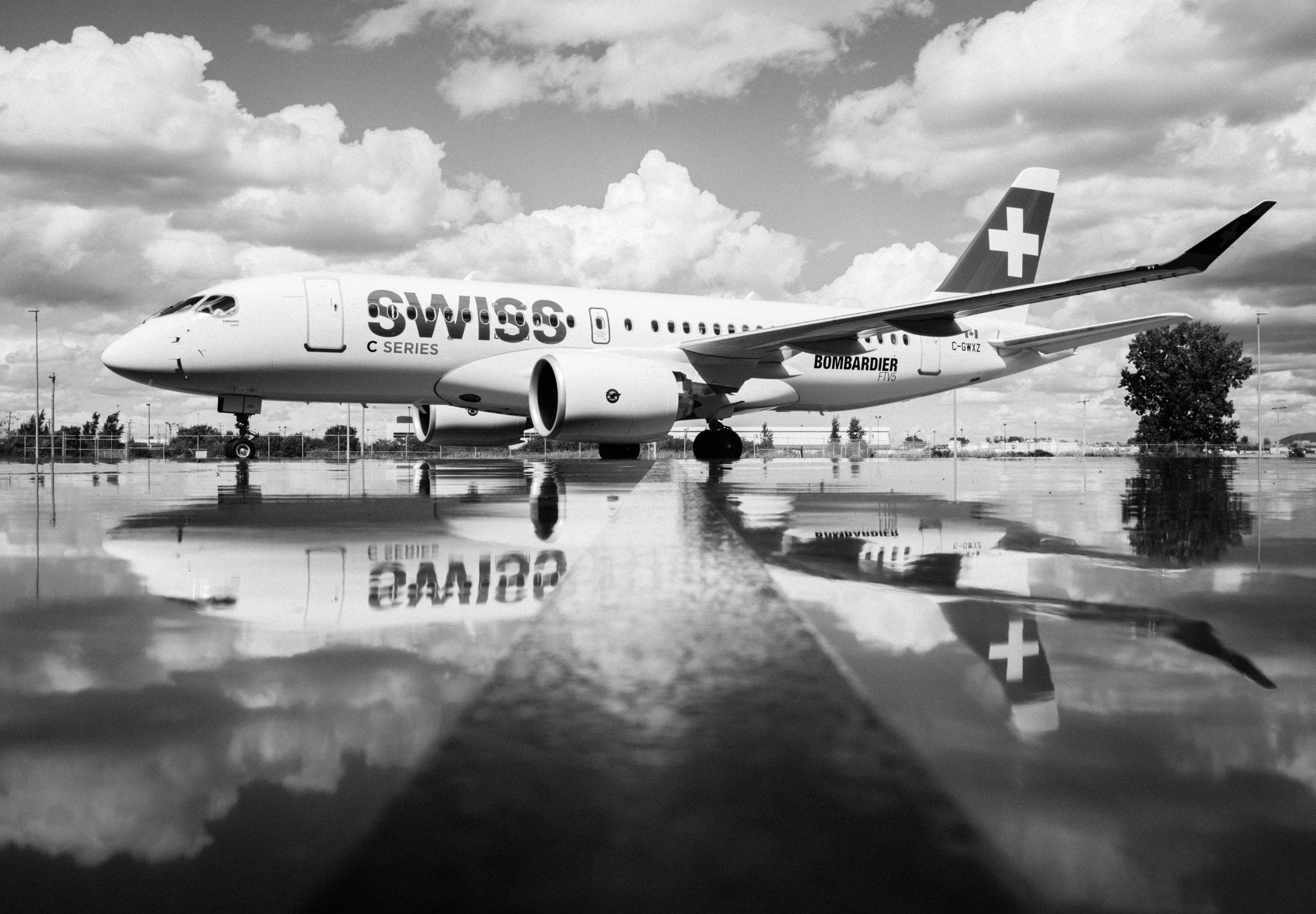 |
| C Series CS100 aircraft with launch customer Swiss livery. Photo: Bombardier |
AirBaltic is Bombardier’s launch customer for the CS300, scheduled to take its first delivery of the aircraft in the fourth quarter of this year and, according to AirBaltic CEO Martin Gauss, the European carrier will transition to an all-Bombardier fleet by 2019. During the AirBaltic-Bombardier press conference, Rob Dewar, vice president of the C Series program at Bombardier Commercial Aircraft, said that the aircraft is equipped with avionics to meet all of the existing airspace avionics equipage mandates in Europe, as well as those coming into effect in 2020.
“The C Series has the most advanced cockpit in the industry,” said Dewar. “It comes standard with Automatic Dependent Surveillance-Broadcast Out and In (ADS-B Out and In), Required Navigation Performance (RNP) 0.05, and terrain mapping … we really took an easier approach to the cockpit. Training time, instead of the typical 30 days, is now down to 20 days. And the large screens with cascading menus provide all of the information that the pilot needs when [he] needs it. The feedback we’ve had from pilots as they test it, as well as the authorities, has been very positive.”
Additionally, the C Series model aircrafts are also equipped to meet the European Aviation Safety Agency (EASA) Link 2000 airspace mandate for aircraft to be equipped with Controller to Pilot Data Link Communications (CPDLC) avionics.
AirBaltic Senior Vice President of Flight Operations Pauls Calitis told Avionics Magazine that for the Latvian carrier, the C Series is a “game changer” in terms of what it will provide for pilots going forward.
“The C Series brings us into a different league in terms of avionics and airspace capability. There is no issue with or any restriction in terms of operating within European airspace, it is fully packaged and ready for all the requirements both existing and coming up in the near-term,” said Calitis.
With eight different companies supplying avionics technologies for the C Series, airlines such as AirBaltic have options in terms of how they want to customize the cockpit. Calitis said the AirBaltic pilots appreciate the large format displays and find real value in the information management capabilities featured on the displays.
“With the large format displays not only can you input a lot of information, it’s also a task or one of the issues is to manage that information and this is where we have the possibility to set it up in different configurations, take on different layers when they’re needed, and take them out when they’re not needed,” said Calitis. “While airborne, there is real value in the large maps, and the dynamic capability featured on the displays where you can change them on the fl; when different issues arise within your flight path you can pull up that information and then eliminate it when you don’t need it.”
Despite interest in the large format displays, the airline ultimately decided not to select the standard class Electronic Flight Bag (EFB) provided as standard equipment on the aircraft in favor of the EFBs that the airline is already using.
“The real benefit for the pilots is the fact we’re working with a totally clean sheet design that is put together in such a way that the pilots are in a fully digital, very useable and operable environment in terms of operating the aircraft. So it’s completely different in terms of any previous generation aircraft and this is where the modern cockpit is going,” said Calitis.
After the press conference, Bombardier allowed journalists and customers to tour the Swiss Airlines CS100 that they had on display at Farnborough, giving Avionics Magazine a first-person view of the setup. The cockpit is spacious for a regional jet, with four multi-function displays, a Heads Up Display (HUD) on the captain’s side, as well as side-stick controls, which is a production first for a Bombardier airframe.
 :
: