Global Aviation Round-Up from Aircraft Value Intelligence (AVN)
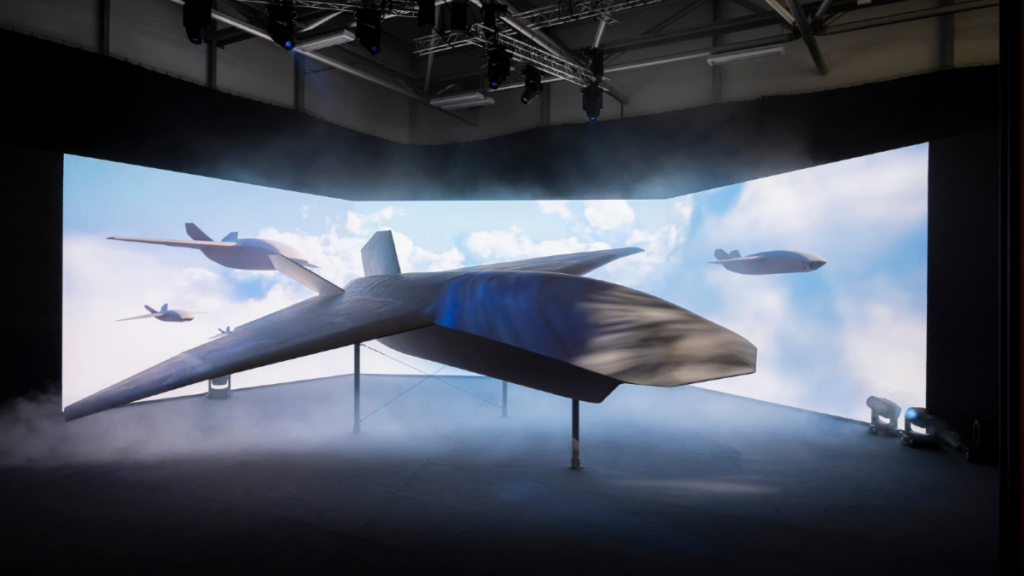
Pictured is a BAE Systems depiction of Brontanax Collaborative Combat Aircraft.
Editor’s Note: To watch John’s video presentation of this article, click here.
The image of the lone fighter ace dominating the skies has defined air combat for more than a century. That picture is beginning to change.
The next generation of aerial warfare is increasingly centered on teams in which a human pilot directs multiple autonomous aircraft, each capable of carrying out dangerous missions that once required another person in the cockpit.
That future moved a significant step closer on July 15, 2026, when the U.S. Air Force announced that an unmanned fighter drone had successfully launched an AIM-120 Advanced Medium-Range Air-to-Air Missile during a live-fire test over the Mojave Desert.
The aircraft, Anduril’s YFQ-44A, is one of the leading contenders in the Pentagon’s Collaborative Combat Aircraft (CCA) program, an ambitious effort to redefine how American airpower operates.
The missile test was more than another weapons demonstration. It showed that autonomous combat aircraft are progressing beyond surveillance and reconnaissance roles into missions that demand split-second decision-making in contested airspace.
While human operators remain responsible for authorizing the use of force, these aircraft are being designed to maneuver independently, coordinate with crewed fighters, and react far faster than traditional remotely piloted drones.
The CCA program reflects a broader shift in military thinking. Rather than relying exclusively on increasingly expensive manned fighters, the Air Force envisions a force structure in which relatively affordable autonomous aircraft accompany advanced jets such as the F-35 and the forthcoming Next Generation Air Dominance (NGAD) fighter.
These robotic wingmen would extend the combat radius of crewed aircraft, carry additional missiles, conduct electronic warfare, gather intelligence, jam enemy radar, and, when necessary, enter heavily defended airspace that would expose human pilots to unacceptable risks. In effect, one pilot could command an entire formation of autonomous aircraft, multiplying combat power without multiplying the number of aircrews.
The concept also addresses one of the Pentagon’s biggest challenges: cost. Modern stealth fighters have become extraordinarily capable, but they are also extraordinarily expensive to build and maintain. Losing even a single aircraft in combat carries enormous financial and strategic consequences.
Collaborative Combat Aircraft are intended to be significantly less expensive than traditional fighters while remaining sophisticated enough to contribute meaningfully to high-end combat operations. Military planners envision buying these aircraft in substantial numbers, creating a force that is both more resilient and more difficult for adversaries to overwhelm.
Momentum behind the program continues to build. On June 17, the Air Force awarded additional CCA contracts aimed at accelerating development of autonomous mission systems and refining aircraft designs. Officials have emphasized rapid prototyping and fast iteration, hoping to field operational aircraft years sooner than would have been possible under traditional acquisition timelines.
Similar Efforts Across the Pond
The United States is hardly alone in pursuing this vision. Across the Atlantic, the United Kingdom is investing heavily in autonomous combat aviation as part of its broader Future Combat Air System strategy.
During the Farnborough International Airshow on July 22, BAE Systems introduced Brontanax, a new uncrewed combat aircraft concept designed to operate alongside Royal Air Force fighters.
According to the company, Brontanax is intended to serve as a force multiplier, performing reconnaissance, electronic warfare, and strike missions while integrating closely with crewed aircraft. Flight testing is expected to begin in 2027, with operational deployment targeted around 2030 if development proceeds as planned.
The parallel efforts in the U.S. and Britain underscore a growing consensus among Western militaries. Future air superiority will depend not only on building better fighters, but also on building smarter teams in which humans and autonomous systems work together seamlessly.
Artificial intelligence lies at the heart of that vision. Modern autonomous aircraft process enormous amounts of sensor data, identify potential threats, recommend tactical responses, and coordinate with nearby aircraft in real time.
Yet military officials consistently stress that these systems are designed to assist human decision-makers rather than replace them. The goal is not to remove pilots from the battlefield but to allow them to command increasingly complex operations without becoming overwhelmed.
That distinction is important because autonomous aircraft remain subject to strict operational controls. Human commanders retain authority over critical decisions, particularly the use of lethal force. Even as AI becomes more capable, military leaders continue to emphasize the importance of keeping people responsible for combat decisions.
For aerospace manufacturers, these developments represent one of the industry’s fastest-growing markets. Companies that can master autonomous flight software, secure communications, advanced sensors, and collaborative mission management stand to benefit from what could become one of the largest defense procurement efforts of the coming decade.
For military strategists, the implications are even broader. Air combat may soon revolve less around one fighter engaging another and more around interconnected networks of crewed and uncrewed aircraft operating as a single, coordinated force.
The fighter pilot is not becoming obsolete. Instead, the role is evolving into something more akin to a battlefield commander directing a team of intelligent robotic wingmen. Judging by the milestones reached this summer, that transformation is no longer a distant possibility. It has already begun.
John Persinos is the editor-in-chief of Aircraft Value Intelligence.
 :
: