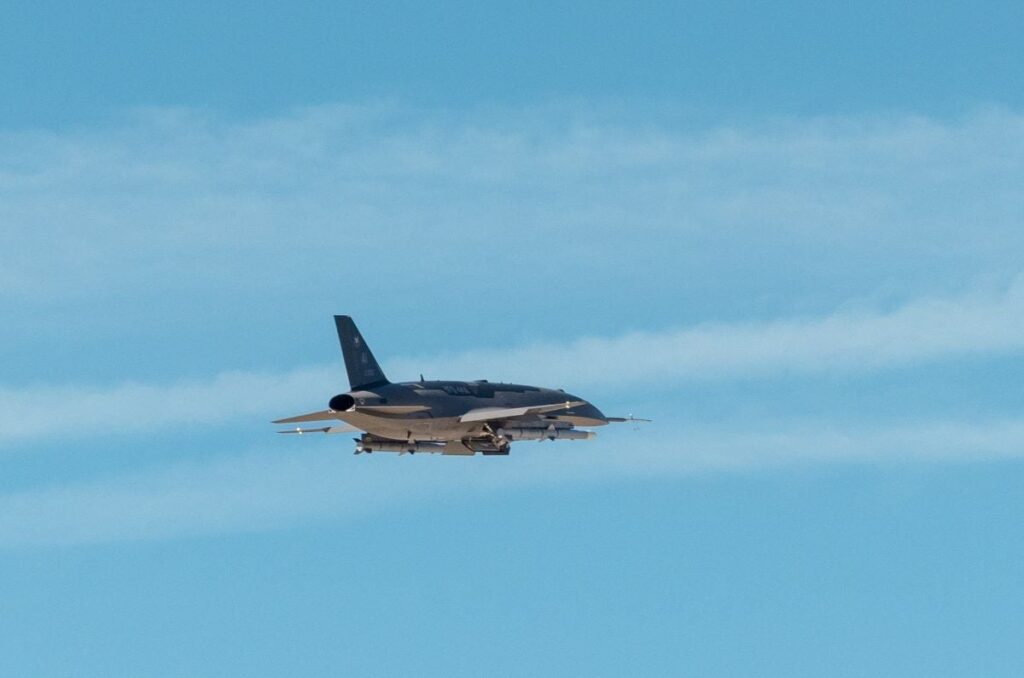
Pictured is a U.S. Air Force photo of an Anduril Industries YFQ-44A flying over Edwards AFB, Calif. during a test by Air Combat Command’s Experimental Operations Unit.
DAYTON, Ohio—Pratt & Whitney‘s Engine Core Upgrade (ECU) for the F-35 fighter’s F135 engine is to have a critical design review (CDR) in August.
After CDR, ECU is to undergo ground testing “late next year, and then from there flight testing in the 2030 time frame–we’re on target,” John Sneden, the Air Force Life Cycle Management Center’s (AFLCMC) program acquisition executive for propulsion, told reporters on Monday at AFLCMC’s annual industry days conference.
In September 2024, the Defense Department said that it had awarded Pratt & Whitney a more than $1.3 billion cost plus incentive fee contract for the ECU to provide more cooling and power for the F135. The military services have said that F135 cooling and power enhancements are needed to allow the Lockheed Martin F-35 to accommodate new weapons and the new, planned radar, the Northrop Grumman AN/APG-85 radar.
The Air Force said that it decided, for cost reasons, to scrap the Advanced Engine Transition Program in fiscal 2024 and move ahead with ECU.
Pratt & Whitney said that it has spent more than $1 billion in the last five years to boost engine production.
Collaborative Combat Aircraft
While fighters, such as the F-16, have used thrust weights of 27,000 pounds and higher, the Air Force thus far has looked for significantly lower thrust weights for its Collaborative Combat Aircraft (CCA), even as the service says it wants low-end and higher end options for CCA engines.
As an example of the class of engine pursued so far, Anduril Industries‘ YFQ-44A Fury prototype has used a Williams International FJ44 engine with around 4,000 pounds of thrust.
“On the small [thrust] end, we don’t really have systems capable of meeting all our requirements so it’s kind of getting to a place where we can develop those systems in advance of need,” Sneden said. “On the mid-end–5,000 to 6,000 pounds–the why is all attributed to what we think is the right range requirements, the need to power the systems that might be on board CCA, and being able to have the flexibility to go do a wide range of things [with CCA].”
Last month, the Air Force picked Anduril’s FQ-44A and General Atomics Aeronautical Systems, Inc.‘s (GA-ASI) FQ-42A Dark Merlin to continue into the engineering and manufacturing development (EMD) phase of CCA. GA-ASI has not disclosed the engine its prototype is using.
For propulsion on Increment 2 of CCA, “we have two legs–a small engine leg, our 1,400 to 1,600 pound engine going through its preliminary design activities that started in the May timeframe, and then we have a medium class, 5,000 to 6,000 pound engine,” Sneden said. “That’s either going to be looking at a ground up, new design, or we’ll use modified COTS [commercial off-the-shelf]. The reason we’re not taking something off the shelf is because we think the requirements and needs are gonna be greater for CCA, Increment 2, and we need to have propulsion systems ready for them.”
A version of this story originally appeared in sister publication Defense Daily.
 :
: