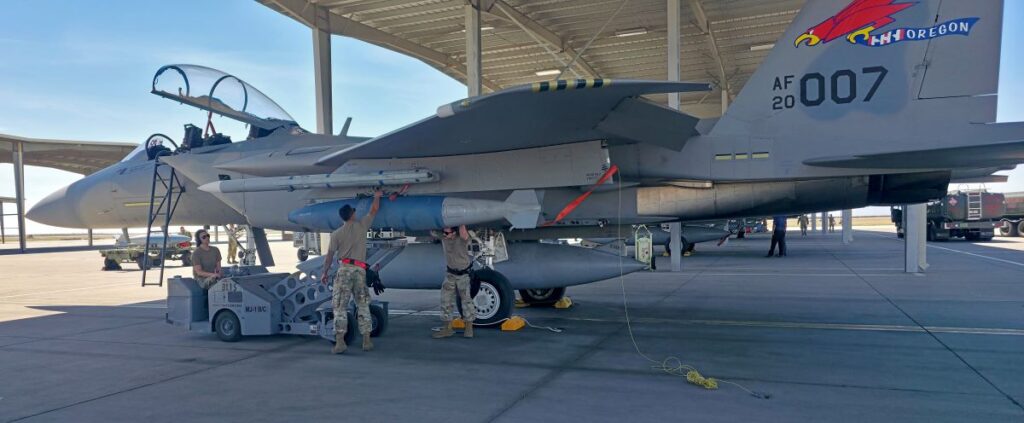
Pictured is a U.S. Air Force photo in May of personnel at Mountain Home AFB, Idaho loading a BDU-56 inert practice bomb onto an F-15EX fighter with the Oregon Air National Guard’s 142nd Wing, the first one to receive F-15EXs for operations.
The U.S. Air Force is searching for answers on how to remedy supply chain bottlenecks in building engines for the service’s F-15EX fighter by Boeing and F-16 by Lockheed Martin.
The Air Force “is embarking on a multi-year procurement of engines for its fighter fleet, with a
projected peak demand of over 180 engines per year by FY 2034,” according to a Aug. 3 business notice. “The current industrial base has demonstrated significant challenges, including production delays, quality control issues, and critical obsolescence (i.e. diminishing manufacturing sources and material shortages) across key engine components. The government will pursue a strategic competition requiring industry to innovate manufacturing and guarantee supply chain resiliency.”
The notice said that the Air Force seeks to “deliver and sustain a decisive edge in airpower by fielding an advanced, reliable, and affordable propulsion enterprise for USAF/FMS [foreign military sales] aircraft (e.g. F-15EX and F-16).”
“We will achieve this through a revolutionary, performance-based competition that harnesses
industry innovation, secures our industrial base, and guarantees unrivaled flight line readiness for the war fighter,” the notice said, adding that the Air Force wants to hear from companies on the highest risk industry faces in increasing engine production, such as “raw material constraints (e.g. for specialized titanium/nickel alloys or manufacturing process bottlenecks (e.g., advanced casting or forging capacity).”
The Air Force is to require the delivery of engines that reduce instances of Mission Impaired Capability Awaiting Parts (MICAP).
On the support side, the competition “is designed to solve key fleet-level issues by requiring a newer engine with improved supportability, directly addressing and decreasing supply MICAPs,” the notice said.
The F-15EX has the F110-GE-129 engine by GE Aerospace. The F-16 Block 70 uses the F110, and the F-16 Block 72 has the Pratt & Whitney F100-PW-229 engine. The engines generate about 29,000 pounds of thrust.
The Engine Core Upgrade for the F135 engine by Pratt & Whitney is to have a critical design review later in August, followed by ground testing late next year and flight testing in 2030. The F135 powers Lockheed Martin’s F-35 fighter.
 :
: