|
 |
 |
 |
Today at Farnborough, seasonable weather returned — i.e., it rained. Typically, more than half of the days in Britain are overcast. The last few years, though, Britain has experienced unusually hot weather during July, spawning concerns about climate change. But today, in a development sure to please environmentalists everywhere, I got thoroughly rained on. And no, I had the benefit of neither an umbrella nor a raincoat.
(Quick fact: Did you know that the United Kingdom’s geographical land mass is slightly smaller than the state of Oregon? And to think, at its zenith, the British Empire once controlled a quarter of the globe. Well, to be fair, Britain chose to decolonize on its own free will.)
Anyway, inside one of the air show halls where it was dry, I did have the benefit of a face-to-face meeting with Aviation Today’s U.K.-based editor, Paul Leighton, who serves as editor-in-chief of our biweekly newsletter Aircraft Value News. He’s also managing director of the Aircraft Value Analysis Co., the headquarters of which is in Stratford-upon-Avon, otherwise known as Shakespeare country.
(To find out more about Aircraft Value News, go to: http://www.aviationtoday.com/subscribe.htm)
Paul is pleasant and unassuming in a very British way. But don’t let his low-key demeanor fool you: he’s an intensely intelligent chap with a keen analytical mind. We sat down at a conference table in the Aviation Today booth at Farnborough for a discussion of topical news that has emerged at this show. Below are excerpts of the salient points:
John Persinos: How have high oil prices and the spreading global recession affected aircraft values and leasing rates?
Paul Leighton: The older aircraft have been particularly affected as operators not only seek more efficient equipment but contract fleets to concentrate on the higher yielding routes. Aircraft being delivered are once again being used as replacement rather than growth capacity and there is a definite emphasis on larger equipment as a means of reducing unit costs.
However, current market conditions differ from previous recessions. The U.S. operators are experiencing the worst while operators in most other regions are managing to avoid large fleet contractions. While there is a clear preference for more modern equipment, absence of delivery slots in the near term is making it necessary to acquire some older equipment, notwithstanding the restrictions on the age of imported aircraft.
Which existing aircraft models are particularly susceptible to today’s adverse economic and energy conditions?
The B737 Classics, 50 seat regional jets, and older widebodies are vulnerable, though shorter sectors will mean that the fuel component of direct operating costs are less notable.
The last recession demonstrated all too clearly that B737s in less than optimum condition were quickly consigned to the desert, ultimately destined to be parted out. The potential need to invest millions to bring the aircraft back into an attractive condition is not viable in a market that is seeing a sustained fall in value.
Meanwhile, as far as 50 seat regional jets are concerned, these aircraft are continuing to experience considerable difficulty in the face of even higher fuel prices.
A number of carriers are divesting part of all of their fleet of regional jets and with a sustained rise in fuel prices, there remains the prospect of further rises in availability. The values of the 50 seaters have suffered while those for larger examples have remained stable. Should the price of fuel continue to rise or even remain at current levels, there is an expectation that further disposals of 50 seaters will be made, undermining values.
Isn’t there an upshot to high oil prices, in the sense that oil sheikdoms are recycling petrodollars to make aircraft purchases?
There is naturally an opportunity for some Middle Eastern carriers to take advantage but they still need the transit traffic to fill aircraft. Fortunately, most recently announced orders involve delivery of aircraft in the future rather than today.
Some analysts say that aviation will decline 40 percent after 2010. Do you think that’s too pessimistic?
A 40 percent drop in passenger traffic is far too pessimistic.
Aviation is managing to stay buoyant over the short term, because of a huge backlog of orders. When do you think this backlog will ease to the point of no longer being a driver of growth?
There are already holes appearing in the delivery schedule but there will continue to be a scramble for more efficient equipment. Even so, if the current market conditions prevail through the rest of the year, then deferrals to deliveries will negate the positive impact on values and even the values of more modern aircraft will become vulnerable to reduced passenger traffic on a more global basis.
To what extent will high oil prices actually drive demand for aircraft? Operators will need fuel-efficient models. Is there a silver lining here with high fuel costs, because it will spur the replacement of aging gas-guzzling legacy aircraft?
Yes, there is a demand for fuel efficient equipment, but airlines need to be able to afford to buy/lease such aircraft and with greater losses comes the prospect of lesser ability to buy new aircraft. Certainly, if oil prices remain at current levels aircraft built before 1995 will be under severe threat from replacement/retirement.
What have you learned this week at the Farnborough Air Show?
That sometimes there can be too much focus on the problems of the U.S. carriers — the aviation market is global. The cyclicality of the industry is well known; the aviation industry will adapt to new market conditions.
Despite the pressures facing the U.S. market, the orders placed during Farnborough underscore the fact that aviation is international in nature. Notably, orders worth $43 billion at list prices, or $25 million at net prices, from Etihad clearly demonstrated that some sectors are able to shrug off industry woes. (end of interview)
And finally, I’ll address the very latest reader question posed on this blog:
“I’m curious as to whether the European Union’s emissions trading scheme to combat global warming came up at the show and what its impact will be on aviation.”
Yes, concerns about climate change and the emissions trading issue caused quite a ruckus at Farnborough. The European Parliament voted last week to mandate emissions permits beginning in 2012 for all flights that land or take off in the European Union zone, regardless of the airline’s nation of origin or the degree to which the flight occurs in European airspace.
To say the least, this decision was not popular with aviation honchos in attendance at Farnborough. At an industry forum here, International Air Transport Association (IATA) director general Giovanni Bisignani dismissed the plan as “greed” on the part of the EU. Meanwhile, in remarks to the press, Airbus president Tom Enders branded the EU’s policy “a scandal”.
Bisignani and Enders’ argument: only by making money can the industry afford to replace aging aircraft with more fuel-efficient models. A new “green tax”, they contend, would only make matters worse, both financially and environmentally. Considering the dire condition of the industry right now, I think their complaints have considerable merit.
Even so, that cracking sound you hear is the industry’s leadership bending over backwards as far as possible to prove how green they are. Dominating Boeing’s exhibit, for example, is a 75-gallon tank of luminous green algae, the potential source of a bio-fuel alternative to jet fuel. For its part, Bombardier has seeded the entire show site with recycling bins, proclaiming: “A new planet, a new plane,” a clear reference to its new C-series jet, which the company claims consumes up to 20 percent less fuel than competing aircraft models. To be sure, some of this breast-beating about environmentalism is just corporate propaganda, but a lot of it is genuine. After all, companies have an incentive to promote fuel efficiency, because burning less fuel saves another type of green: money.
This is my final dispatch. Soon, I’ll be at Heathrow to catch a plane home. Wish me an aisle seat.
My headline above conjures images of a bad Ed Wood movie (actually, “bad Ed Wood movie” is a tautology). Regardless, the headline is inspired by one of the hottest areas in aviation today: Unmanned Aerial Vehicles (UAVs). I turn my attention this evening to UAVs, in response to this new question from a reader:
“Have you seen or heard anything in regards to unmanned helicopters at the air show? Boeing has the A160 for military application but I’m curious if the industry is touting any for civilian applications such as search and rescue.”
Yes, UAVs are exerting a high profile at Farnborough. That’s because defense strategists are enthusiastically embracing unpiloted drones, which they perceive as the exemplification of netcentric, transformational warfighting capabilities. These futuristic devices undertake the work that flesh-and-blood humans find too difficult or dangerous. The fact is, UAVs are the perfect soldiers. They’re always willing to die for their country. And they’re increasingly deployed for search and rescue.
To combat terrorism and guerrilla warfare, the United States is funneling huge amounts of money into its UAV and airborne surveillance programs, a trend that’s likely to continue even if defense spending retrenches next year, as most analysts expect.
According to Forecast International, aerospace consultants based in Newtown, Connecticut, the global market for UAV Reconnaissance Systems, including airframe vehicles, ground control components and electronic payloads, will be worth $13.6 billion through 2014.
As for the A160 “Hummingbird” that our reader mentions, Boeing suspended flights of the long-endurance aircraft after it crashed last December in California. It wasn’t the first crash for the aircraft. Development of the unmanned helicopter has been funded by the U.S. Defense Advanced Research Projects Agency and Special Operations Command.
UAVs nonetheless loom large at Farnborough this year. Displayed at BAE’s pavilion here is the new Ampersand Unmanned Autonomous System (UAS). It is a rotary winged counterpart to the company’s motor-glider-based Herti. The aircraft adds BAE’s autonomous UAV system and a Herti-type sensor suite to an autogyro platform. The Ampersand is intended for maritime or naval applications, landing on and taking off from small ship platforms.
BAE also is spotlighting its Mantis UAS advanced concept technology (ACT) demonstrator program. The twin-engined Mantis tests and integrates technology that’s intended for incorporation in future U.K. unmanned systems. Design and manufacture of the aircraft already is proceeding; final assembly and testing will occur later this year, with first flight slated for early 2009. Mantis will feature an external stores carriage and encompass a range of “plug and play” systems. The overall goal of Mantis’ capabilities will be flexibility, low cost and ease of support.
Meanwhile, General Atomics Aeronautical Systems is showing off its Predator and Sky Warrior UAVs, which are seeing active service in Iraq and Afghanistan. Predators have appeared in major media around the world, after using Hellfire missiles to obliterate important insurgent targets. The Sky warrior is a variant of the MQ-9 Predator B.
Rockwell Collins and Thales have been trumpeting the versatility of the Watchkeeper WK450 UAV under development for the British Army in cooperation with Elbit Systems. The WK450’s relatively hefty payload capacity and the structural integrity of its wings allow this UAV to carry weapons, an increasingly desirable scenario as far as military planners are concerned. Rockwell Collins provides the UAV with the “Athena” guidance and navigation systems.
It’s true, as our reader suggests, that UAVs are increasingly deployed for non-military uses in the civilian sector, such as for firefighting, airport security and search and rescue. The Global Hawk, in particular, has been put to good use in the recent past, fighting fires in California.
At Farnborough this week, Northrop Grumman’s exhibit pavilion showcased a broad array of UAVs, notably the MQ-8B Fire Scout vertical take-off and landing UAV, as well as the RQ-4 Global Hawk high altitude, long endurance unmanned system, including the marine version selected by the U.S. Navy for the Broad Area Maritime Surveillance Unmanned Aircraft System program. Full sized models of Global Hawk, Fire Scout and the Unmanned Combat Air System demonstrator are prominent in the open air static display area.
Okay, our reader has provided me with enough homework for one evening. (Thanks a lot, pal.)
I need to take a break. The last two nights in London, I’ve overindulged my fondness for Indian food. London, of course, is the best city in the world to procure Indian cuisine. The denizens of the Empire’s former colonies all flock to this cosmopolitan city and set up ethnic eateries, which is why the city is home to so many Caribbean, Indian and African restaurants. Now, as I type this blog, my gut is churning with a toxic mixture of bad coffee and festering vindaloo. Exacerbating matters, I have bandages on my blistered feet, I’ve been sweating all day in my wool suit, and my head is pounding from one too many Kingfisher beers the night before. I’m also dying for more air conditioning; there just isn’t enough AC in this country. So, please allow this humble scribe and wage slave to depart for the evening. I’ll be back at my post, tomorrow.
Another day over; another pair of loafers ruined. Now, I’m rolling up my sleeves, pouring yet another cup of sludge-like coffee, and digging right into reader comments. Feedback to my Farnborough blog has been candid, provocative and well-informed. Let’s stoke the conversation.
A reader posts this comment:
“At every international air show, the rivalry between Airbus and Boeing tends to dominate. What transpired, in terms of these two giant OEMs? And what’s the latest that you’ve heard, in regards to the controversial tanker deal? Considering Boeing’s shady behavior on this deal in the past, I think the government should have just banned Boeing from the playing field. What do your sources say?”
To answer the first part of your question, Boeing aggressively emerged from the gate at Farnborough and sealed two huge deals. Etihad Airways, the United Arab Emirates’ national airline, agreed to buy 45 Boeing mid-sized passenger jets, including 35 787 Dreamliners, in a deal worth $9.4 billion. Etihad is slated to take delivery of ten 777s in 2011 and 35 Dreamliners in 2015. At the same time, FlyDubai agreed to buy 54 single-aisle Boeing 737 passenger jets for $4 billion.
Meanwhile, Airbus announced that it had won a $1.6 billion order from Saudi Arabian Airlines for eight wide-bodied A330s, with additional contract wins to be announced at Farnborough later this week.
The story behind the news: These huge contract wins are a vote of confidence in the future and in Boeing and Airbus. They underscore that airline operators are still hanging in there. Despite all of the hand-wringing right now in aviation about high fuel costs and economic recession, OEMs are nonetheless announcing splashy deals at Farnborough. Also, don’t forget that impatience with Boeing over 787 snafus, and with it the threat of canceled orders, loom large over the company’s future. However, the delayed status of the Dreamliner doesn’t seem to be deterring major customers. Boeing is still riding high in the commercial sector.
As for the second part of your question, the answer is much murkier. The Pentagon’s decision last week to reopen the competition for KC-X midair refueling tankers for the United States Air Force (a roughly $40 billion deal for 179 tanker aircraft) stunned the industry — and at Farnborough, the decision seems to have cast a shadow over the European Aeronautic Defense and Space Company (EADS).
The sudden risk of losing the plum contract, awarded in February to a consortium of EADS and Northrop Grumman, has added a wild card to the Boeing-Airbus game. “It’s all so disingenuous and it involves so much politics and posturing,” one aviation analyst told me. “Supply chains that are involved in producing either the Boeing or the Airbus tanker are truly international. Boeing is wrapping itself in the American flag, but both companies rely on subcontractors from all around the planet. Neither competing version of the aerial tanker is a purely national product.”
Regardless, the reopening of the tanker deal also has reopened old wounds between the European and American companies, as well as between their respective parent governments. European executives here are muttering that the reopening of the bid was influenced by electoral politics. And more than just Boeing and Airbus are at stake: their subcontractors stand to win or lose, on a grand scale. For example, Alenia Aeronautica, a unit of Finmeccanica of Italy, has $900 million in work on the Boeing alternative at risk.
The Pentagon’s decision, spurred by a report from the U.S. Government Accounting Office (GAO), hands Boeing a fresh shot at a contract it recently lost. It’s a complex tale. The initial Boeing win on aerial tankers — i.e., the ill-fated and tawdry leasing deal, way back in 2002 — resulted in the conviction on corruption charges of a Boeing official instrumental in the award, opening the door for the EADS-Northrop team to win the bid in February ‘08. Boeing says it intends to hold fast to its original entry in the reopened rebidding for the tanker contract.
In its scathing review of the bidding specifications and process, the GAO asserted that the USAF gave additional credit to the EADS/Northrop alternative, the A330 from EADS subsidiary Airbus, because the A330 was larger and could carry more fuel. Boeing howled in protest, because it had put itself at an unwitting disadvantage by offering its smaller 767-based aircraft. Neither company expects the request for proposal to formally make size an overriding criterion. Consequently, Airbus expects to offer the same plane again; Boeing is still mulling over whether to offer a “stretched” version of the 767, or the bigger 777, but it’s holding to the view that its version is “right sized” for the job.
Another reader asks: “Did you see any surprising new ‘green technologies’ at the show?”
To be sure, there has been a plethora of ecology-minded innovations emphasized at the show. They involve the usual suspects: more efficient engines, cleaner maintenance methods, etc. I’ve written about these initiatives in previous blogs at previous air shows; they’re becoming perennials that companies trot out to prove their green credentials. They’ve also been topics of several Aviation Today podcasts and webinars. But one emerging technology for cleaner skies took me aback: wind tunnels.
One of the joys of attending air shows is the opportunity it affords to rub elbows with your old cronies. I met up with an old colleague, Ian Parker, and chatted with him. Ian, a pilot and longtime aviation journalist, served for years as my European columnist when I was editor-in-chief of Rotor & Wing magazine. Ian now edits Global Wind Tunnel Journal, of all things. A sardonic Englishman of John Cleese-style wit, Ian imparted a few surprising insights.
“Today’s aviation crisis is largely fuel-cost based, in common with the similar crises in other forms of transport,” he said. “Anything that reduces fuel consumption and noise has to be good for all transport, and the wind tunnel industry, although tiny, will become more and more vital to the development of efficient transport.”
Ian also had a few choice words to say about the Farnborough show itself. “Farnborough is having a major battle with ILA Berlin,” he said. “It seems that Farnborough’s attendance is down this year. Farnborough moved its slot on the calendar from September to July, thinking that it would undermine the Berlin show. The opposite is happening.” (Or as another of my colleagues put it: “Farnborough has been hoisted by its own petard.”)
Ian speculated that the Berlin show, which immediately precedes Farnborough in late May, is stealing audience share. “Plus, the Germans give a lot of money to the Berlin show,” he said. “And the exchange rate is a big problem this year. Aviation companies are fearing recession and, when you add all of the other factors that I just mentioned, many of them just decided to skip the show this year. And we journalists are aggravated by Farnborough. The commute is terrible. It takes a long time but you just get up and do it, because you get used to it, I suppose.”
The shocking exchange rate (about $2.00 to a single English pound) was on the lips of many attendees. “Attendance seems to be down at the show,” said Jean-Christophe Monfret, product management director, avionics division, Barco. “When times get tough, marcom budgets are the first to get cut. And I’m sure the exchange rate has a lot to do with it.”
Monfret says his company, a maker of aircraft displays, was determined not to skip the show this year because it had major news to herald. Notably, Barco won a contract from Thales to supply Multipurpose Control Display Units for the Dassault Atlantique 2 fleet and Lockheed C-130H, operated by the French military. The deal is part of a major technology upgrade that will outfit both aircraft types with a new Thales TopDeck avionics suite. Deliveries will start later this year.
Under the agreement, Thales will integrate more than 100 CDMS-3000 units into the C-130 cargo planes used by the French Air Force and the Dassault Atlantique 2 patrol aircraft deployed by the French Navy.
So, despite the specter of recession, deals are being made at Farnborough. That’s not to say our industry doesn’t face big trouble ahead.
The knowledgeable folks at AeroStrategy, a consultancy that specializes in the MRO market, are in attendance at Farnborough. Over the years, they’ve also proven themselves to be friends of this web site. They’ve provided Aviation Today with useful data for its webinars and podcasts. At Farnborough this week, AeroStrategy analysts released data on how high fuel prices and spreading economic recession are forcing a restructuring of the $45 billion air transport MRO market. AeroStrategy released the following conclusions:
- In recent months, more than 25 different airlines have announced the grounding of just over 610 aircraft – about 3.2% of the active global fleet.
- Not surprisingly, it’s the older aircraft being grounded because of their fuel burn characteristics – 67% are old version 737s (not NGs) and DC9/MD-80s.
- 80% of aircraft being taken out of service are in North America (accounting for almost 7% of the fleet there).
- Removal of these aircraft from the active fleet will reduce annual MRO spend by $1.35B – around 3% of the total market.
- If fuel prices continue to remain high, AeroStrategy estimates about 1,200 aircraft will ultimately be removed from service, reducing MRO spend by about $2.8B (6%).
- In addition, recessionary pressure will reduce growth, although the impact will be offset by the continuing strength in developing regions.
AeroStrategy paints a stark picture. However, as mentioned above, the $25 billion worth of orders from the Middle East announced this week at Farnborough, for 150 Airbus and Boeing airliners, certainly helps dispel some of the pessimism.
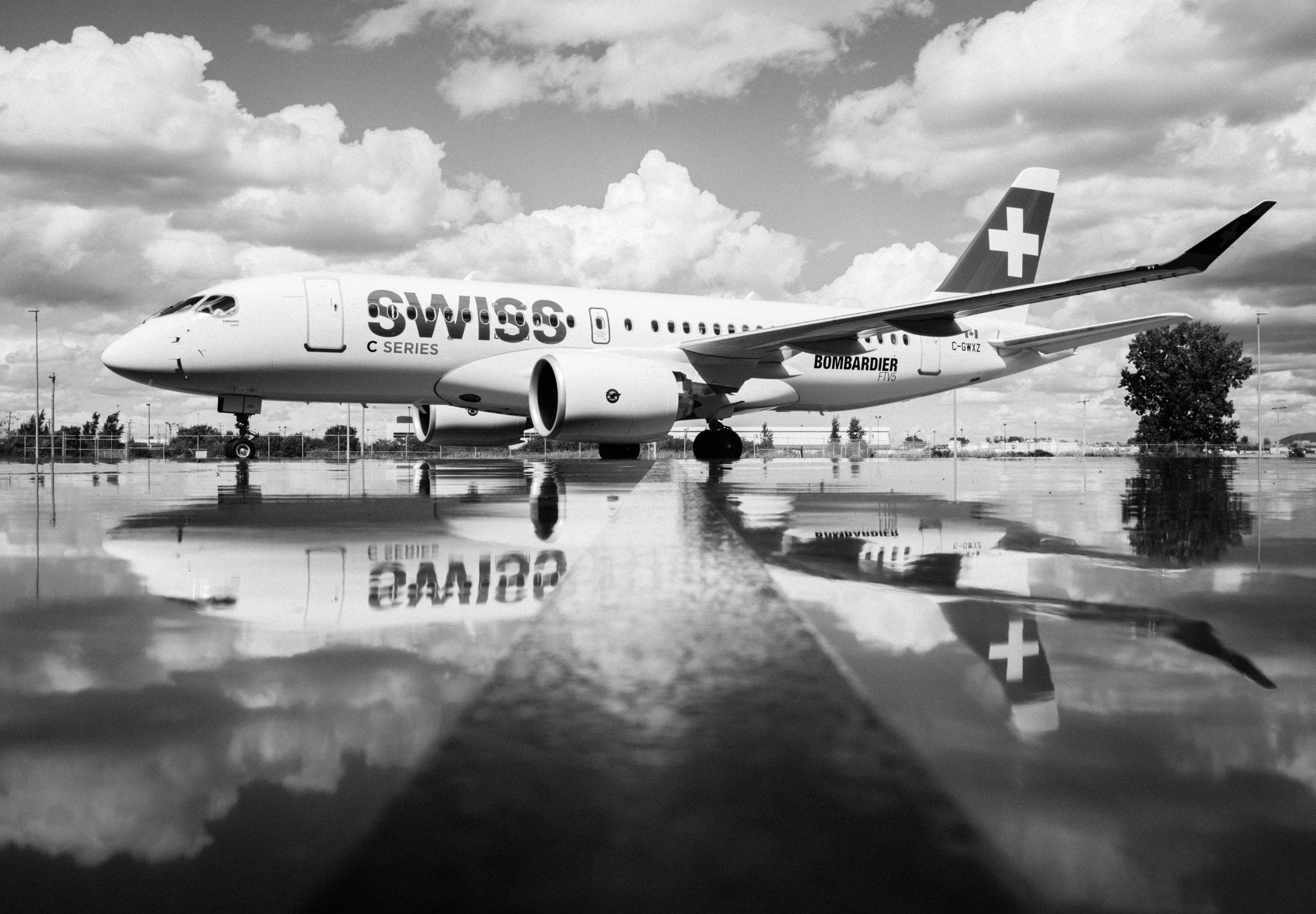
Another jolt in the industry’s arm was when Bombardier finally — finally! – launched its long-deferred CSeries, with a $2.8 billion order from Lufthansa. The first of the five-model 110 to 149-seat CSeries is scheduled to enter service in 2013. The Pratt & Whitney Geared Turbofan (GTF) got the nod as the CSeries powerplant of choice. “Embraer, not to mention Boeing and Airbus, now have a new challenger breathing down their necks,” one analyst told me.
So, this venerable show in the U.K., celebrating its 60th anniversary, has been a venue for good news, bad news, and everything in between. Let’s see what tomorrow brings. So long, until then.
I’ll devote most of today’s dispatch to answering some of the comments that I’ve received from readers. That’s one of the powerful aspects of a blog: it’s an interactive, participatory medium. The “social community” created by blogs is good for any industry and it’s intellectually stimulating for participants.
One reader comments, in part:
“As you reported, the Middle East is an attractive source of orders; China, India, Russia and Brazil continue to post strong economic growth, might they not also fuel demand? (Until they develop viable domestic commercial-aircraft industries, that is.)”
Yes, that’s certainly true. Those four countries are resilient sources of demand amid today’s slowdown in the aviation sector. At Farnborough, the European consortium EADS is touting the signing of a $360 million contract between Russian and European shareholders in the Airbus Freighter Conversion (AFC) joint venture. The AFC program expects demand for 400 conversions by 2015 and is slated to begin deliveries in 2011.
Meanwhile, Sukhoi is pushing at Farnborough its SuperJet-100, a regional aircraft designed to seat 75 to 95 passengers. It’s the first post-Soviet aircraft, with 75 orders already in hand. More than 40 international contractors, notably Thales and Goodrich, are undertaking work on the jet. The jet is a watershed for the Russians: it’s the first aircraft completely designed in the post-Soviet era and it’s just the beginning of Russian aviation’s efforts to target the country’s new breed of oil-rich oligarchs with regional jets. Remember the depths of the Cold War, when Russian engineering was maladroit and mostly considered a laughingstock? When Lada automobiles would blow up on the street and lumbering Mil helicopters would get shot down from the sky by guerrillas with slingshots? Sukhoi is determined to change that image of its mother country.
At the show, Sukhoi chief Mikhail Pogosyan discussed the company’s enhanced Su-35 that recently finished its initial phase of test flying. He said the Su-35 is in the vanguard of Russian aviation technology, although he admits that the country in general and his company in particular “lags” in composite materials development.
Also highly visible at Farnborough is China’s Chengdu Aerospace Jian-10 (J-10) fighter jet, which is on display. China’s aviation sector continues to boom, along with the rest of its economy. More than 40 airports are now on the drawing board in China. The massive country boasts the role of global production site of the Embraer ERJ145 and has sufficient orders to maintain production for another three years. Overall deliveries of Embraer’s ERJ family topped 1,000 in September. At the show, Embraer spread its influence even deeper into China, by announcing the sale of five Embraer 190 aircraft to regional carrier Kun Peng Airlines in a deal worth $187 million.
Last but not least, the Andhra Pradesh State Government in India inked a deal for an AgustaWestland AW139 medium twin helicopter, bringing to 20 the number of commercial helicopters that AgustaWestland has on order in India. What’s more, India’s latest 777-300ER long-range airliner is on display at Farnborough. The aircraft is the 10th 777 delivered to Air India from its 2005 order of 68 Boeing aircraft.
Another blog reader writes, in part:
“The airline industry is a disaster, and no Qatar Airways and Air Arabia purchases will be able to hide it. The thing I find most frightening about the morons that run the airlines is how unimaginative their thinking is. It’s easy to run a business when times are good. But look at them now. They appear to be as clueless as any executive in any line of work.”
Good point! It’s true: a rising tide lifts all boats, as laissez faire capitalists like to say. But there’s an even better aphorism that I prefer, uttered by those unsentimental traders on Wall Street who practice truly raw capitalism: Don’t confuse a bull market with brains. I try to remember those words, when I hear the hyperbole at Farnborough over business jets.
When a market is growing, most players thrive and everyone looks like a bloody genius. However, the business cycle still hasn’t been repealed. When the bubble invariably bursts, the inherent weaknesses of companies, products and individuals emerge. Flaws become apparent, weak competitors fall behind and the only fittest stay afloat. In a bear market, as black ink turns to red, all of those “geniuses” who got a free ride suddenly look like, to borrow a British term, “wankers”.
Take business jets, which are all the rage among the aviation cognoscenti. The most sanguine analysts predict that the next 20 years will witness demand for 23,000 new corporate jet aircraft, from Very Light Jets (VLJs) through business jetliners. At Farnborough, Cessna announced that it expects its European Citation fleet to surpass 1,000; there are now more than 900 Citations on the Continent. At a press conference, Cessna chief Jack Pelton said he expects his company to add 100-125 Citations each year for the next two or three years.
At the same time, Eclipse Aviation let it be known at the show that the European regulatory body EASA is easing up its pressure on the Eclipse 500 VLJ. Indeed, there’s every indication that EASA will give the aircraft its certification by the end of 2008.
Maintaining a high profile at the show is Japan’s Mitsubishi Heavy Industries and its 70-90 seat regional jet, the MRJ. Likewise, Honda is shining a spotlight on its HondaJet, an aircraft it’s targeting toward the growing VLJ market, which the company estimates now encompasses 1,000 aircraft. Honda will produce 100 HondaJets a year starting in 2012.
However, someone influential begs to differ with the conventional cheerleading over business jets. At the show, I spoke with Richard Aboulafia, vice president of analysis at Teal Group, an aviation consultancy in Fairfax, Virginia.
Aboulafia forecast deliveries by 2018 of 3,365 VLJs, with 1,385 Cessna Citation Mustangs, 925 Embraer Phenom 100s, and 1,055 spread among other makes and models, such as the Eclipse 500. He noted that Eclipse may be selling aircraft, but it’s “burning cash”. He says Eclipse isn’t alone and labeled a lot of pro-VLJ rhetoric as “quixotic”. He also noted that, while Embraer is now successful, the company was a “cash devouring horror” for 30 years before it righted itself.
Bruce Maxwell, president, Luma Technologies, maker of aircraft illumination products, such as LED annunciators and anti-collision lights, casts a positive spin on the bizjet market, saying the air congestion and certification concerns will soon fall by the wayside. He also noted that while the aviation industry is in crisis for some players, for others conditions are favorable.
“There will be a huge crisis for the OEMs, because of recession and high oil prices,” he told me. “I mean, just huge. However, look at it another way. More and more, people will recognize that they can’t afford a new aircraft and instead they will update and refurbish what they have. So, for me, the crisis will be that I can’t keep up with demand.”
I’ll end on that positive note. More tomorrow. Keep those comments coming!
Ruing Britannia
Most aviation journalists dread the Farnborough Air Show, but we’re compelled to attend anyway. The daily commute to the airfield taxes both body and spirit and occurs in the middle of stifling summer weather. During the previous Farnborough that I attended, the temperature in the London subway, a.k.a. “The Tube”, literally reached a breathtaking 120 degrees Fahrenheit. The British once mastered the globe, but they can’t seem to master something as basic as air conditioning. Ice cubes are rare commodities here, as well. When it comes to the difference in certain creature comforts between the U.K. and America, you’d better mind the gap.
Then there’s the biennial air show itself, which according to my local time here in London officially starts tomorrow (Monday). It’s undoubtedly Europe’s biggest aviation event this year, chock full of exhibitors, flight demonstrations, important news, deal making, and hordes of decision-makers and C-level honchos. An aviation journalist such as myself really can’t afford to miss it. This week, the Farnborough confab, held just outside London, will serve as Mecca for 1,500 companies from 35 countries.
Farnborough 2008 is an opportunity to reflect on the crisis now unfolding in aviation – and “crisis” is not too strong a word. Since the Paris Air Show at le Bourget last year, oil has reached astonishing levels, approaching $200/bbl; the U.S. credit crisis has plunged the global financial community into turmoil; Boeing is experiencing unexpected delays with its all-composite 787 Dreamliner; Airbus’s superjumbo A380 is plagued with its own production snafus and delays; airlines are slipping into red ink; passengers are thoroughly disgusted and on the brink of rebellion; airline ticket prices are rising while quality of service is plummeting; and no genuine progress has been made with implementation of ADS-B, the “NextGen” blueprint for Air Traffic Control.
These are predominant issues, sure to be broached this week at Farnborough, which is a predominant venue. However, because Farnborough is administered by the Brits…well, the show’s disorganization is legendary. Farnborough’s organizers make the fictional hotelier Basil Fawlty seem like an exemplar of organizational acumen by comparison. No wonder the British lost their colonies. (Prediction: Scotland is next.) I’d relate to you the grief I experienced this afternoon, just trying to get my press pass, but it’s a convoluted tale that doesn’t lend itself to concision.
Ah, but then there’s the Royal Aeronautical Society Award Banquet, a reliably posh affair from which I’ve just returned. Like many writers, I grouse about the Brits, but I’m really an Anglophile at heart. We scribes are suckers for the mellifluous, condescending tones of a BBC-Oxbridge accent. We go to bed at night, hoping that in the morning, we wake up to find ourselves English. If I weren’t trying to make ends meet and put a kid through college on a journalist’s salary, I’d buy a few Saville Row suits.
Tonight, I was able to immerse myself in unadulterated Anglophilia at the Royal Lancaster Hotel in London, where the “Aerospace Journalist of The Year Awards Ceremony” was held amid considerable pomp and circumstance just moments ago.
I won’t act as a mere stenographer and list the award winners for you; you can look all that up at http://www.world-leadership-forum.org. But I will vouchsafe a few conversations that I had at the reception and dinner and convey to you remarks that I feel are indicative of what to expect at the show for the rest of this week.
The overriding issue: oil. As of this writing, oil hovers at about $140/bbl. Volatility in the oil markets has been dizzying. What’s worse, refinery production of jet fuel is particularly tight. Oil prices are expected to remain high for quite some time, and that’s devastating news for aviation. The International Air Transport Association (IATA) announced last month that losses for the entire airline industry worldwide would reach $6.1 billion in 2008 if oil remained in the $135/bbl range.
Complicating matters is a decision by the European Union in June that forces all airlines flying into European airports to purchase pollution credits, starting in 2012. This latest environmental mandate is exacerbating airlines’ anxieties and is viewed as yet another threat to already battered bottom lines. The upshot: the Farnborough show this week is likely to be infused with fear, uncertainty and doubt.
This “FUD Factor” was the omnipresent mood at dinner conversations at the Royal banquet – enough to add a quiver to even the stiffest of upper lips.
Some cooler heads advise caution, though. “Crisis? Well, let’s put it this way. There definitely is a confluence of issues coming to the fore at Farnborough that’s affecting the health of the aviation industry,” said T.K. Kallenbach, vice president of marketing and product management at Honeywell Aerospace.
Mr. Kallenbach, a gregarious and knowledgeable fellow who sat next to me tonight at dinner, called for a little perspective from the industry’s Chicken Littles. “Whether oil prices were high or not, issues like air traffic congestion would still cause economic difficulty – as it did last year,” he said. “From an air traffic management perspective, we’d still be focused on the problem of crowded skies.”
Emily McGee, director of communications, Flight Safety Foundation, also broke bread with me at the Lancaster Hotel this evening. She disputed the oft-repeated assertion that airline cutbacks are harming air safety. “As airlines cut costs, we need to keep at eye on the industry to make sure safety doesn’t suffer,” she asserted. “Frankly, we’re not seeing that yet.”
J.A. Donoghue, editor-in-chief, AeroSafety World, echoed those sentiments this evening. “The notion that increased outsourcing of MRO work is undermining aircraft safety is perhaps a bit overblown,” he told me. “But then again, you never know what’s lurking beneath the waves.”
Others didn’t mince words: They think aviation is heading into serious turbulence.
“At the show this week, listen skeptically to the announcements made by Boeing and Airbus,” one well-informed dinner attendee told me. “They’ll focus on the short-term, which remains positive, and the long-term, which also remains somewhat positive, but both companies will do their best to dissemble about the intermediate term. That’s where the real uncertainty and danger lies. With the price of oil the way it is, and the specter of global recession, all bets are off for the aviation industry. Aircraft OEMs will get hit with a brutal downturn after 2010.”
It’s true that in the matter of a few months, aviation has gone from unprecedented prosperity to profound worry, mostly because of the debilitating effects of spiking oil prices. Many operators and their suppliers face deep retrenchment, if not outright bankruptcy.
Paradoxically, high oil prices are both hurting and helping aviation: hurting because jet fuel is frightfully expensive, of course, but also helping because Sheikdoms are recycling their petrodollars into major aircraft purchases. Indeed, analysts I spoke with tonight are predicting major orders at Farnborough from Middle Eastern operators, such as Qatar Airways and Air Arabia.
Keeping the industry buoyant, now and for the next several months, is a hefty backlog of orders from Middle Eastern countries. Also buttressing the aviation industry is high defense spending, especially in such homeland defense-related areas as rotorcraft.
“Increased spending on homeland defense is helping our sector, that’s apparent,” said Kimberly Kasitz, communications manager, General Atomics, makers of unmanned aerial vehicles (UAVs).
Also making the rounds as conversational “buzz” at the Royal banquet was the controversial $40 billion aerial tanker deal for the U.S. Air Force.
“The GAO has issued its decision,” said one banquet participant tonight, “but we’re still far off from a definitive decision. If a re-compete indeed comes to pass, who knows whether the Northrop Grumman-EADS KC-30 wins or the Boeing KC-767 wins. Remember, though, that the fight over this very lucrative tanker contract is another manifestation of the eternal Boeing-Airbus rivalry. I frankly think the GAO’s decision was unnecessary, but what’s done is done.”
Speaking of which, I’m done for the evening. Look for fresh dispatches in this space, every day this week. As always, I welcome readers’ comments. Wish me luck in The Tube tomorrow.
|
|
|
 |
 |
|
 |
|