Global Avionics Round-Up from Aircraft Value News (AVN)
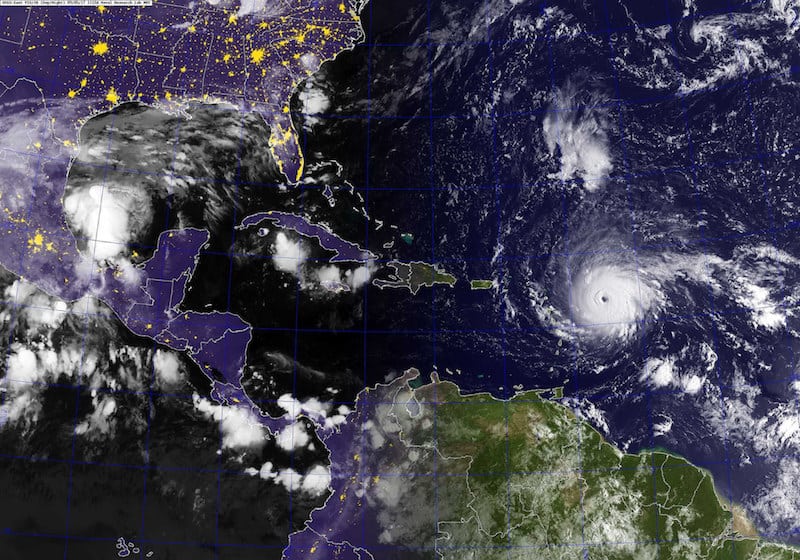
ATLANTIC OCEAN (Sept. 5, 2017) A GOES satellite image showing Hurricane Irma in the Atlantic Ocean. (U.S. Navy photo/Released) 170905-N-N0101-001
For decades, turbulence was treated as a known nuisance—unpredictable, occasionally dangerous, but broadly manageable within the design assumptions of modern aircraft. Engineers modeled it, pilots trained for it, and passengers endured it.
However, the atmosphere those assumptions were built on is changing. Global warming is not just nudging temperatures upward; it’s reconfiguring the invisible architecture of the skies. The result is a measurable rise in both the frequency and intensity of turbulence, especially the most insidious kind: clear-air turbulence that strikes without visual warning.
This shift is proving to be more than a meteorological curiosity. It’s exposing a gap between the turbulence environment aircraft were designed for and the one they increasingly encounter. And that gap is beginning to ripple through avionics design, airline operations, and even aircraft valuation models.
The Growing Menace of Clear-Air Turbulence
At the heart of the issue is the jet stream. As the planet warms, temperature gradients between the equator and the poles are evolving, altering the strength and structure of high-altitude winds. Stronger wind shear—sharp changes in wind speed and direction over short distances—creates ideal conditions for clear-air turbulence.
Unlike convective turbulence associated with storms, this variety offers no visual cues. It doesn’t show up on traditional weather radar, and it can materialize abruptly in otherwise calm skies.
Recent studies suggest that severe clear-air turbulence has already increased significantly over key transatlantic and transpacific routes. For airlines, that translates into more frequent encounters that can injure passengers and crew, accelerate airframe fatigue, and disrupt schedules.
For avionics and airframe manufacturers, these factors raise a more uncomfortable question: were aircraft optimized for a turbulence regime that no longer exists?
Historically, OEMs have balanced structural robustness with weight efficiency. Overbuilding for worst-case turbulence scenarios adds weight, which increases fuel burn and erodes operating economics. Underbuilding risks safety margins. The industry has long relied on statistical models of atmospheric behavior to strike that balance. But those models are being overtaken by climate-driven variability.
The immediate response is not to redesign airframes wholesale. Instead, the pressure is falling squarely on avionics—on the systems that sense, predict, and respond to the atmosphere in real time. If turbulence is becoming harder to avoid and more damaging when encountered, then detecting it earlier and mitigating its effects becomes critical.
Modern weather radar, a cornerstone of cockpit situational awareness, is optimized for precipitation. It excels at identifying convective cells but is largely blind to clear-air turbulence. That limitation is now front and center.
Avionics suppliers are racing to close the gap, exploring technologies that go beyond traditional radar. Lidar, which uses laser pulses to detect minute changes in air density and motion ahead of the aircraft, is gaining renewed attention. While it has long been discussed as a potential solution, the changing turbulence landscape is accelerating its path toward operational viability.
At the same time, data is becoming as important as hardware. Aircraft are increasingly acting as nodes in a global sensing network, sharing real-time turbulence reports through systems like ADS-B and satellite links.
The idea is simple: if one aircraft encounters turbulence, others can be warned within minutes. But scaling that concept into a predictive, global turbulence map requires sophisticated data fusion, machine learning, and low-latency communications, all of which fall under the expanding umbrella of avionics.
Airframers and airlines are also revisiting flight control systems. Fly-by-wire architectures already allow for envelope protection and automated responses to certain flight conditions.
The next step is more dynamic turbulence mitigation, which calls for systems that can adjust control laws in real time to smooth out the ride, reducing both structural loads and passenger discomfort. This is not about eliminating turbulence, which is physically impossible, but about dampening its impact.
Halfway through this transition, a new reality is setting in: turbulence is no longer just an operational variable; it’s a design driver.
From Weather Avoidance to Atmospheric Intelligence
This shift in mindset is reshaping how avionics are conceived. Instead of treating the atmosphere as something to avoid when possible, the emerging approach treats it as a complex, data-rich environment to be continuously analyzed and managed. That distinction may sound subtle, but it carries profound implications.
For one, it blurs the line between onboard systems and ground-based infrastructure. Predicting turbulence in a warming world requires integrating satellite observations, numerical weather models, and real-time aircraft data into a cohesive picture.
Avionics systems are becoming interfaces to that ecosystem rather than standalone tools. Connectivity, once a passenger-facing amenity, is now mission-critical.
It also changes certification dynamics. Introducing new sensing technologies like lidar or advanced predictive algorithms is not just a matter of engineering; it requires regulatory frameworks that can validate their reliability and define how pilots should use them. The certification process, already lengthy, must adapt to a faster pace of technological change driven by environmental pressures.
Airlines, for their part, are recalibrating operational strategies. Flight planning is becoming more dynamic, with routes adjusted not just for winds and fuel efficiency but for turbulence risk. That can mean longer flight times and higher costs, but also fewer injuries and less wear on aircraft.
Over time, these trade-offs feed back into fleet decisions. Aircraft equipped with more advanced turbulence detection and mitigation systems may command a premium, while older models could face steeper operating penalties.
The Human Factor
Pilots have long relied on experience and intuition to manage turbulence, supplemented by imperfect tools. As avionics become more predictive and automated, the pilot’s role shifts toward interpreting and trusting those systems. Human trust, which is engendered through training, interface design, and system transparency, is as important as the underlying technology.
The implications extend to maintenance and the role of mechanics as well. Increased turbulence exposure can accelerate structural fatigue, particularly in components like wings and control surfaces.
Avionics systems that monitor loads in real time and feed that data into predictive maintenance models are becoming more valuable. In effect, the same data used to avoid turbulence can also help manage its long-term consequences.
For OEMs, the challenge is balancing near-term retrofits with long-term design evolution. It is one thing to upgrade avionics suites on existing aircraft; it is another to design next-generation platforms with a fundamentally different turbulence environment in mind. That could influence everything from wing design to materials selection, but those changes take years, if not decades, to materialize.
In the meantime, the skies are already rougher. What was once a background condition is moving to the foreground, reshaping priorities across the aviation ecosystem. The industry has faced environmental challenges before, from volcanic ash clouds to shifting wind patterns, but climate-driven turbulence is different in its persistence and scope. It is not a temporary disruption; it is a new baseline.
Avionics, often the enabler of aviation’s steady progress, are now at the center of that adaptation. The race is on to turn a more chaotic atmosphere into something that can still be navigated with precision and confidence. Whether that race keeps pace with the changing climate will determine not just how smooth future flights feel, but how resilient the entire system proves to be.
This article first appeared in our partner publication, Aircraft Value News.
John Persinos is the editor-in-chief of Aircraft Value News.