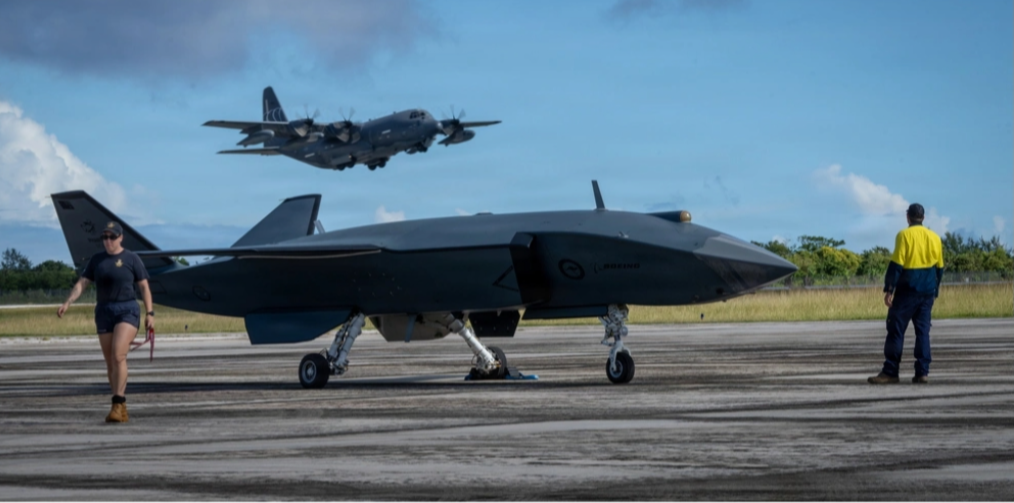
Pictured is a U.S. Air Force photo of an HC-130J Combat King II with the 79th Rescue Squadron taking off behind an MQ-28 Ghost Bat, a production representative test aircraft by Boeing Defence Australia, during Exercise Valiant Shield 2026 at Rota, Commonwealth of the Northern Mariana Islands, on June 21.
As the U.S. Air Force continues to fund the development of Collaborative Combat Aircraft (CCA) by General Atomics Aeronautical Systems, Inc. (GA-ASI) and Anduril Industries, Pacific Air Forces (PACAF) said that it is integrating Boeing‘s MQ-28 Ghost Bat with U.S. and allies during this month’s Exercise Valiant Shield.
“This marks a significant milestone in the operational development of CCA and the advancement of human-machine teaming in the Indo-Pacific theater,” according to PACAF. “During the exercise, the uncrewed MQ-28 will fly in concert with crewed fighter platforms, providing a critical opportunity for the joint force to refine tactics, techniques, and procedures for this next evolution of airpower. CCA will perform a variety of missions during Valiant Shield 26 to include defensive and offensive counter air missions.”
Boeing did not have a comment on the use of Ghost Bat during Valiant Shield but said that it hoped “to have more to share soon.”
This month, the company said that it had validated the low Radar Cross Section (RCS) of the Ghost Bat, developed by Boeing’s Australian subsidiary.
“The MQ-28’s RCS reduces the range that enemy radars can detect and engage an MQ-28, enhancing the platform’s survivability in contested environments,” according to Boeing. “The success of the RCS testing confirms the effectiveness of the MQ-28’s design, production and material choices in minimizing radar detection.”
In March, Boeing said that it is teaming with Rheinmetall to offer Germany Ghost Bat by 2029 as a CCA for that country.
The MQ-28 began development in 2017 and flew for the first time in 2021.
This month, the Air Force picked the GA-ASI FQ-42A Dark Merlin and the Anduril FQ-44A Fury for CCA Engineering and Manufacturing Development, and the service is to start Increment 2 this year.
Boeing said that the MQ-28 has fired an Advanced Medium-Range Air-to-Air Missile against a target drone, teamed with other Ghost Bats and with an E-7A Wedgetail airborne early warning aircraft and an F/A-18F Super Hornet.
CCA Numbers
The fiscal 2027 Air Force budget requests $1.1 billion to begin CCA production, but the service has declined to provide numbers on how many CCAs that funding would buy. In addition, the Air Force fiscal 2027 budget would fund CCA research and development at nearly $1.4 billion.
The service estimates fielding more than 150 CCAs by 2029 out of a total buy of about 1,000, yet that goal may increase significantly.
CCA EMD is to cover the first three production lots toward the goal of more than 150 by 2029.
An Increment 1 CCA’s range is to be more than 700 nautical miles, yet that distance would possibly not suffice for the vast distances in the Indo-Pacific. Refueling options for CCAs are classified, according to the Air Force.
Two years ago, the Air Force said “exquisite” CCAs could have a flyaway cost between $25 million and $30 million, but the service forecast a possible move toward a CCA mix with more attritable systems around a price of $5 million to $10 million per copy. At the high-end unit cost of $30 million that may be appropriate for early stage CCAs bought with fiscal 2027 dollars, the Air Force would be able to buy about 36 CCAs.
Air Force Secretary Troy Meink has suggested that CCAs would not be in the attritable cost category.
After this month’s Valiant Shield, the Air Force and allies are to analyze Ghost Bat’s “contribution as a force multiplier that extends the reach, awareness, and survivability of crewed platforms in contested environments,” according to PACAF. “The Department of the Air Force remains steadfast in its commitment to the ethical development of these systems, ensuring that a human remains in the loop for all critical decisions. These platforms are designed to increase sortie generation with less strain on maintenance and personnel, which ultimately makes our entire force more lethal.”
A version of this story originally appeared in sister publication Defense Daily.
 :
: