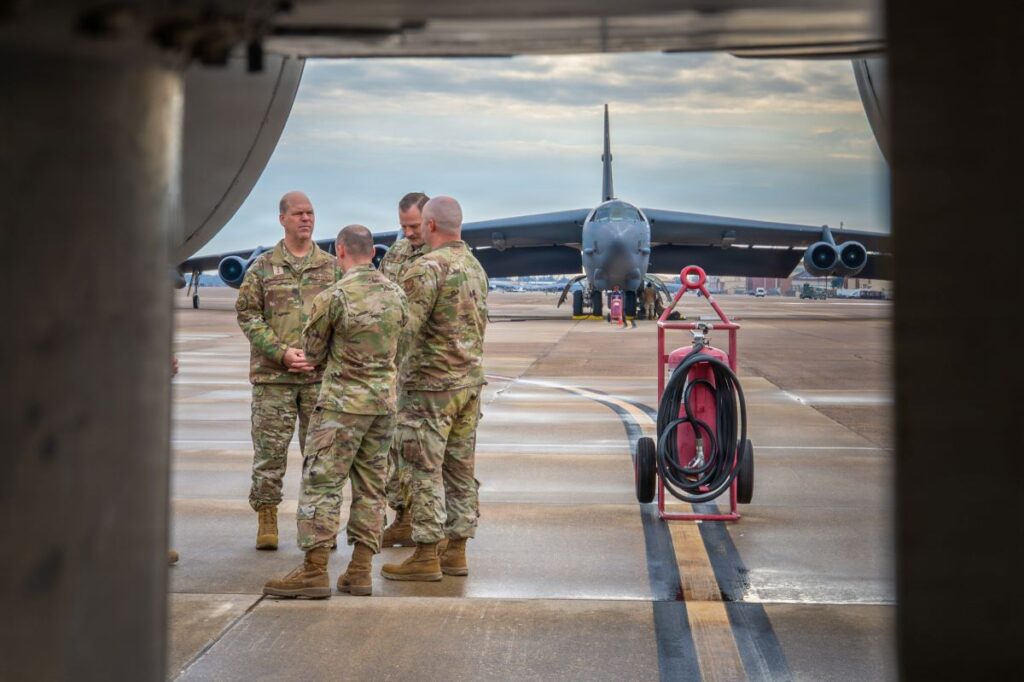
Pictured is a U.S. Air Force photo of Air Force Gen. S.L. Davis, the head of Air Force Global Strike Command, meeting with personnel during a maintenance immersion at Barksdale AFB, La. on Dec. 17, 2025.
Rolls-Royce said on Feb. 24 that it has completed altitude and operability testing for the company’s F130 engine as part of the U.S. Air Force’s Commercial Engine Replacement Program (CERP) modernization for the B-52, which will convert from the H model to the J model with the new engines and a new radar.
The announcement came as the Air & Space Forces Association held its annual symposium in Aurora, Colo.
Under CERP, the more powerful F130s are to replace the B-52’s eight Pratt & Whitney TF33-PW-103s, and, under the Radar Modernization Program, an active electronically scanned array radar based on RTX’s APG-79 is to replace the bomber’s Northrop Grumman APQ-166.
Rolls-Royce said that it conducted the altitude and operability testing at the Air Force Arnold Engineering Development Complex (AEDC) in Tullahoma, Tenn., “where Rolls-Royce engineering teams worked side-by-side with the Air Force to validate performance in demanding mission conditions.”
“At AEDC, Rolls-Royce conducted altitude tests to demonstrate sustained performance for long-duration, high-altitude strategic missions; operability testing with distortion screens to replicate turbulent, real-world airflow and confirm engine stability under stress; and Integrated Drive Generator testing with Boeing to ensure stable and reliable electrical power during all mission scenarios,” according to Rolls-Royce.
Air Force Lt. Col. Timothy Cleaver, the service’s CERP program manager, said in the Rolls-Royce statement that “completing the series of tests at AEDC’s worldclass facility gives us confidence in the engine and associated systems as we proceed into test aircraft modification and flight testing.”
Rolls-Royce said that the F130s are durable and “low maintenance” and that they “are fully interchangeable in the dual-pod configuration – an upgrade from the current platforms left engine and right engine configuration – which will simplify logistics, improve readiness, and
make maintenance easier.”
“With over 30 million flight hours, the F130’s commercial heritage ensures reliability and a strong global supply chain,” the company said. “As part of the BR engine family, the BR725 engine has been in production for 13 years with more than 1,000 engines flying today. Once production begins, Rolls-Royce will manufacture, assemble, and test the F130 engine in Indianapolis, Rolls-Royce’s largest production facility in the U.S. Rolls-Royce has invested more than $1.5 billion in the U.S. over the last decade, including modernizing Indianapolis facilities to deliver innovation and advanced manufacturing to the Air Force and other customers with American labor.”
In late 2024, the F130 passed an Air Force Critical Design Review.
A version of this story originally appeared in affiliate publication Defense Daily.