Global Avionics Round-Up from Aircraft Value News (AVN)
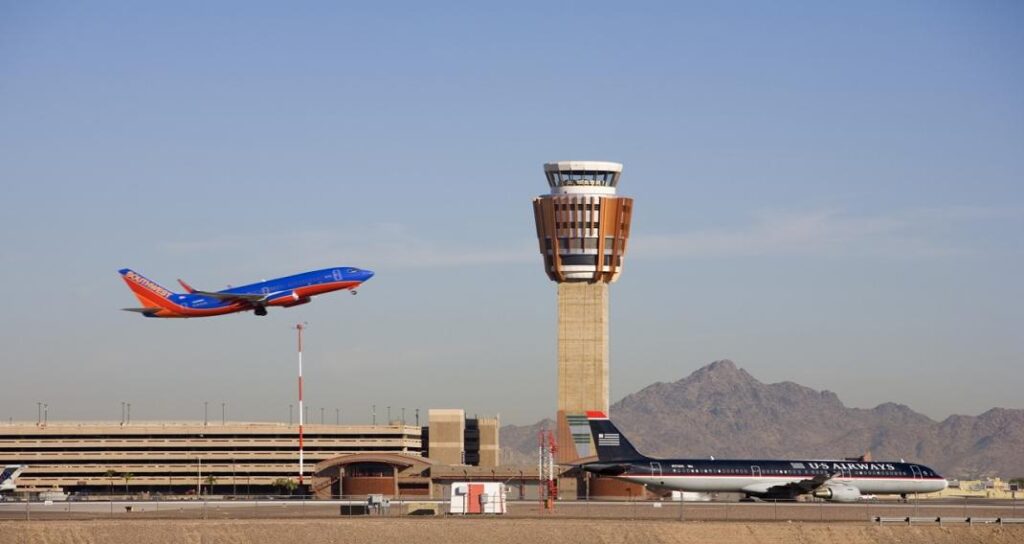
Phoenix Sky Harbor’s Air Traffic Control Tower and TRACON (Photo: Jacobs)
When we talk about avionics development, we often focus on onboard systems, such as chips, sensors, and displays.
However, one outside influence is gaining strategic importance: the staffing and capacity crisis at the nation’s Air Traffic Control (ATC) network is forcing avionics planning and certification timelines to shift, and that has knock‑on effects for aircraft values and lease prospects.
The U.S. Federal Aviation Administration (FAA) and other aviation‑industry bodies are warning of serious staffing gaps. Many U.S. airport control towers are significantly understaffed, with the total certified controller workforce lower than needed for traffic volumes. The U.S. Department of Transportation’s Inspector General has faulted planning to address the shortage of ATC staffing.
Why does this matter for avionics? Because modern avionics systems increasingly depend on advanced communication, navigation and surveillance (CNS/ATM) features that assume availability of upgraded ATC infrastructure and procedures.
For example, systems such as Controller‑Pilot Data Link Communications (CPDLC), ADS‑B In/Out, performance‑based navigation (PBN), and datalink weather and traffic data rely on the broader ATC system working smoothly.
If ATC upgrades or staffing don’t keep pace, the avionics roadmap gets delayed. Suppliers delay roll‑out, OEMs postpone retrofit campaigns, and operators hold off investment.
Avionics upgrade programs that promised near‑term benefits (e.g., reduced workload, airspace access, and fuel savings) might be parked. That reduces the value proposition of the upgrade, and thereby reduces the asset‑value uplift you might expect from earlier avionics refresh. Lease‑rate expectations may fall because the operational benefits are delayed.
Consider a narrowbody operator planning to lease a 10‑year aircraft with an avionics retrofit mid‑term to access more efficient airspace or new approach paths. If ATC modernization stalls, the retro‑benefit drops, with less fuel saving, fewer route‑flexibility gains, and fewer regulatory incentives.
The lessor may thus factor in a lower residual value (because the retrofit may produce less incremental advantage) and lower lease rate (to account for higher risk of delayed retrofit).
Stress on MRO
Moreover, the Maintenance, Repair and Overhaul (MRO) support ecosystem for avionics is stressed when ATC delays accumulate. Operators hold back on new cockpit investments if they can’t guarantee access to the new airspace or communications infrastructure.
There’s also a broader maintenance/training shortage in avionics technology. The paucity of avionics technicians is suppressing demand for aircraft with advanced avionics, because operators hesitate to commit when support is shaky. All of these factors feed into the asset‑value and lease‑rate equation.
Lessors and OEMs are encountering a ripple‑effect. When ATC delays mean fewer available slots, increased airborne delays, and higher operating cost, airlines are more reluctant to invest heavily in cockpit upgrades because the cost‑benefit ratio shifts.
That means some aircraft will live longer without upgrades—and those aircraft, in turn, take longer to reach a “modern cockpit” headline. That delay means slower accumulation of lease‑rate premiums or residual value bumps.
The ATC crisis is a hidden drag on avionics value uplift. It resembles the scenario where you have the latest chip‑based avionics ready to go, but the airspace they promise to exploit is not yet ready. The upgrade becomes “nice to have” rather than “must have.” From an asset‑valuation view, that “nice to have” status implies less premium.
When bidding or planning for aircraft, operators and lessors are increasingly checking not just the avionics suites but also the expected deployment of the enabling ATC systems and staffing. If a region or main base suffers ATC constraints, the value of onboard avionics won’t materialize as quickly or as fully. That means a more conservative lease rate expectation and a more cautious residual value forecast.
The ATC staffing and infrastructure crisis is more than a headline; it‘s reshaping avionics roll‑out timing, investment justification, and ultimately aircraft asset values and lease economics. Smart operators and lessors are treating it as a key risk in the avionics‑upgrade and asset‑life equation.
The article first appeared in Aircraft Value News.
John Persinos is the editor-in-chief of Aircraft Value News.