Global Avionics Round-Up from Aircraft Value News (AVN)
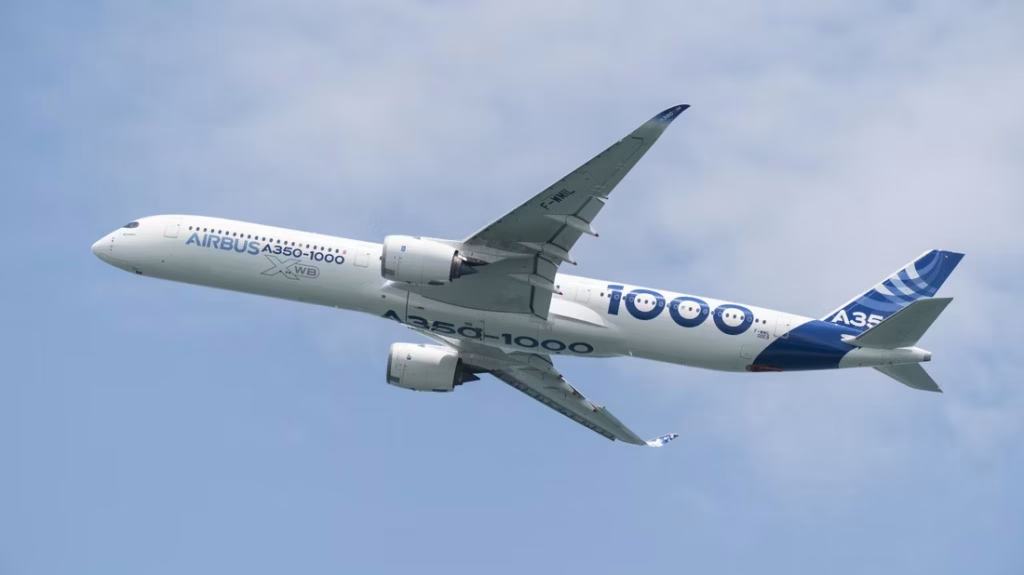
The Airbus A350-1000 jet aircraft
widebody airliner (Photo: Airbus)
The A350-1000 stands as one of the most digitally advanced widebody aircraft in service, and its avionics suite is central to its competitive positioning.
Rather than treating cockpit systems as isolated tools for pilots, Airbus designed the A350-1000’s avionics as an integrated information ecosystem that connects flight operations, maintenance, and airline network strategy.
For appraisers and lessors, this integration directly influences utilization rates, operating reliability, and long-term asset value.
The A350-1000 cockpit is defined by large, highly configurable displays that present flight, navigation, and systems data in a coherent and intuitive manner. This design reduces pilot workload while enhancing situational awareness, particularly on ultra-long-haul missions where fatigue management and decision support become critical.
Airline fleet managers consistently cite cockpit ergonomics and information clarity as contributors to operational consistency, which in turn supports predictable cost performance across long sectors.
At the heart of the avionics suite is a sophisticated flight management system capable of optimizing performance throughout all phases of flight. The system continuously refines speed, altitude, and route predictions based on real-time atmospheric data and aircraft state. Over long distances, small efficiency gains accumulate into meaningful fuel savings.
These savings are not theoretical. They are reflected in operating economics that appraisers incorporate into valuation models, particularly when comparing the A350-1000 to older generation widebodies.
Automation Without Removing the Pilot
The A350-1000’s avionics also support a high degree of automation without removing pilot authority. Automated flight path management reduces workload during routine phases while allowing crews to intervene seamlessly when conditions change.
This balance has become a benchmark in modern cockpit design and is increasingly expected by airlines evaluating future fleet acquisitions. Aircraft that fail to meet this expectation risk being perceived as less future-proof, regardless of their airframe performance.
Beyond the cockpit, the A350-1000’s avionics are deeply integrated with data connectivity and predictive maintenance systems. Aircraft health monitoring data is transmitted in near real time to ground-based analytics platforms, enabling proactive maintenance planning and rapid troubleshooting.
For lessors, this transparency reduces uncertainty around maintenance status and residual condition, supporting more accurate lease pricing and reserve structures. For operators, it translates into higher dispatch reliability and fewer disruptive events.
Global interoperability is another defining feature. The A350-1000’s avionics are fully aligned with performance-based navigation standards, advanced data link communications, and evolving surveillance requirements. This alignment allows airlines to operate the aircraft efficiently across diverse regulatory environments without modification.
The broader impact of the A350-1000’s avionics is evident across the industry. Competing OEMs have accelerated investment in digital cockpit integration and predictive analytics in response to operator feedback shaped by A350 experience.
Airlines now expect widebody avionics to deliver not just compliance, but actionable insight that improves network performance and asset utilization. This expectation is filtering down into retrofit programs for older aircraft as operators seek to narrow the capability gap.
For appraisers, the implication is that avionics sophistication increasingly plays a role in value retention, not just operating cost. Aircraft with deeply integrated digital systems are more likely to remain competitive as regulatory and operational complexity increases. The A350-1000 exemplifies this shift, positioning avionics as a core driver of long-haul fleet strategy rather than a supporting feature.
This article originally appeared in Aircraft Value News.
John Persinos is the editor-in-chief of Aircraft Value News. For recurring updates on aviation topics, subscribe to his YouTube channel: www.youtube.com/@JohnPersinos