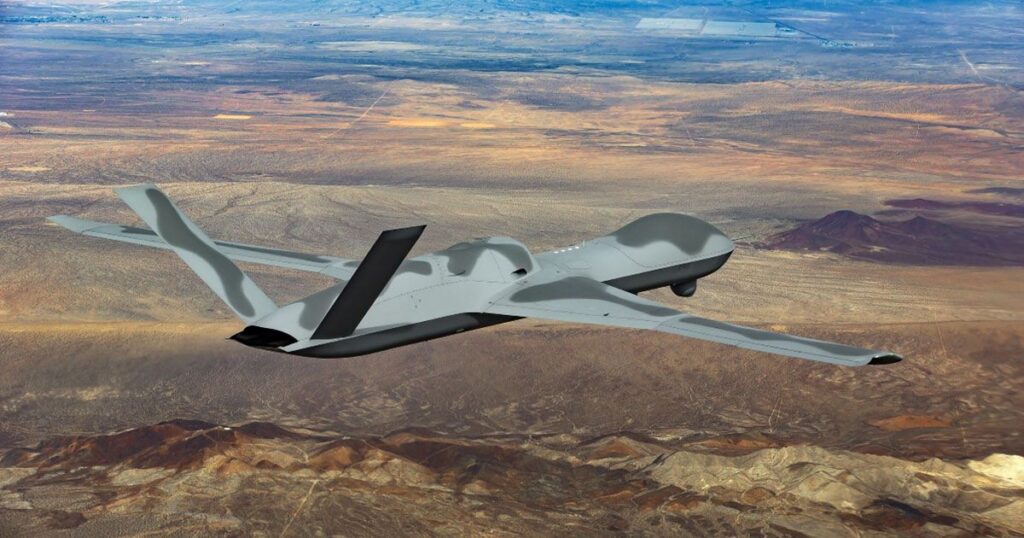
Pictured is a General Atomics MQ-20 Avenger drone (GA-ASI Photo)
General Atomics Aeronautical Systems, Inc. (GA-ASI) on Nov. 17 announced the successful test of an F-22 Raptor fighter controlling an MQ-20 Avenger unmanned combat aerial vehicle (UCAV) for the first time in an industry-funded demonstration of manned-unmanned teaming.
This test occurred at the Nevada Test and Training Range on October 31 using a piloted F-22 integrated with L3Harris Technologies’ BANSHEE Advanced Tactical Datalinks and Pantera software-defined radios (SDR) and Lockheed Martin’s open radio architectures to communicate with a GA-ASI MQ-20.
The company noted two L3Harris SDRs supported this demonstration, one in each aircraft. Lockheed built the Air Force’s fleet of F-22s.
“Through the Pilot Vehicle Interface (PVI) tablet and the F‑22’s GRACE module, the system provided end‑to‑end communications, enabling the F‑22 command and control of the MQ‑20 in flight,” GA-ASI said in a statement.
The company said the event showcased non-government-owned and non-proprietary communications capabilities as well as the ability to fly, transition and re-flight flight hardware that is central to Open Mission Systems and unmanned autonomy ecosystem.
GA-ASI confirmed this is part of an ongoing set of flight demonstrations via internal research and development funds to show off what is possible in manned-unmanned teaming.
General Atomics and Anduril Industries are both developing autonomous air vehicles after they were chosen for the downselect in the first increment of the Air Force’s Collaborative Combat Aircraft (CCA) program last year. Lockheed Martin was previously one of the original five firms contracted for CCA Increment 1 that did not make it to the next round.
General Atomics has been using the UCAV as its testbed for future autonomous collaborative platforms.
This latest test follows a February GA-ASI test demonstrating the MQ-20 flying with a government-furnished reference architecture, allowing a pilot interface with compliant autonomy software. The test also had the aircraft switch between various autonomy systems software as needed.
In June, General Atomics and Shield AI announced an MQ-20 using artificial intelligence-based flight software successfully tested midair station keeping, autonomous decision-making, manned-unmanned teaming, live aircraft intercept of two aircraft and a simulated missile shot of live representative Group 5 UAS.