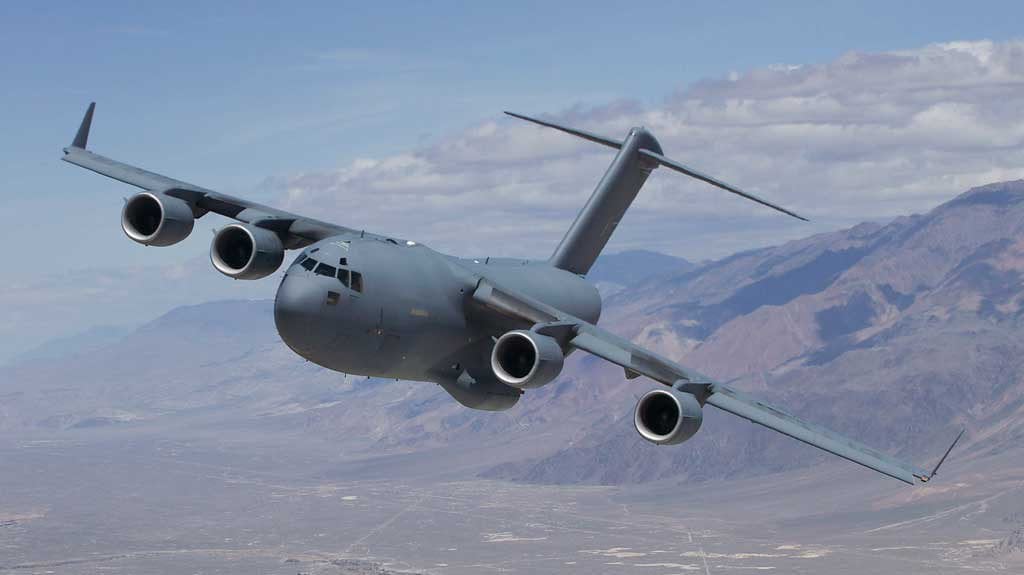
A C-17 Globemaster III
In mid-December, the Air Force awarded Boeing a $266 million sole source contract through 2031 to replace the flight deck of the company’s C-17 airlifter.
The avionics redesign through the use of commercial systems is to address four, critical Line Replaceable Units (LRUs) in the C-17 cockpit that are obsolete–the Multifunction Display (MFD), Core Integrated Processor/Replacement Core Integrated Processor/Modernized Replacement Core Integrated Processor (CIP/RCIP/MRCIP), the Video Integrated Processor (VIP), and the Standby Engine Display (SED).
“The CIP/RCIP/MRCIP and the MFD are obsolete and current spares are projected to sustain the C-17 fleet only through FY 27,” according to a Justification and Approval (J&A) document for the sole source award to Boeing. “The CIP/RCIP/MRCIP serves as the mission computer and brain of the entire C-17 avionics system. It interfaces with approximately 36 flight critical and safety critical LRUs on the two attached mission buses. Five out of six MFD/Heads-Up-Display are required to be functional for aircraft takeoff. These parts are currently unrepairable due to their age and the obsolescence of their components.”
Boeing delivered the C-17s to the Air Force between 1993 and 2013.
As the Air Force develops systems to operate from austere locations and counter adversary attempts to disrupt U.S. military supply chains, the service has sought industry insights on the future Next Generation Airlift (NGAL) plane to replace the 222 C-17s and 52 Lockheed Martin C-5Ms. More than a decade ago, the Air Force said that the C-17s would last until 2040, but now the service projects that some will keep flying until 2075 and that the C-5Ms will keep flying until 2045.
The Air Force is considering pushing up the NGAL Analysis of Alternatives to fiscal 2027 in order to start NGAL production in fiscal 2038 and achieve Initial Operational Capability in fiscal 2041 in a one-for-one replacement of the C-5s and C-17s.
The Air Force did not buy the C-17 technical data package (TDP) from McDonnell Douglas, which merged with Boeing in 1997. The C-17 Flight Deck Replacement “design solution must have the ability to integrate with the larger avionics system and the C-17 weapons system,” the J&A said. “Additionally, the majority of Boeing’s supplier base drawings and data were not provided with unlimited rights. Obtaining unlimited technical data rights from over 800 suppliers is expected to be cost prohibitive. Use of unverified data could require re-qualification, which would be prohibitively expensive.”
“Furthermore, a ROM [rough order of magnitude] request was made to Boeing in October 2023 to request details to to purchase a TDP required for competition,” according to the J&A. “Boeing’s response indicated it would take a considerable amount of time to put a package together and likely cost over $1 billion, which is cost prohibitive for the C-17 platform.”
A version of this story originally appeared in affiliate publication Defense Daily.