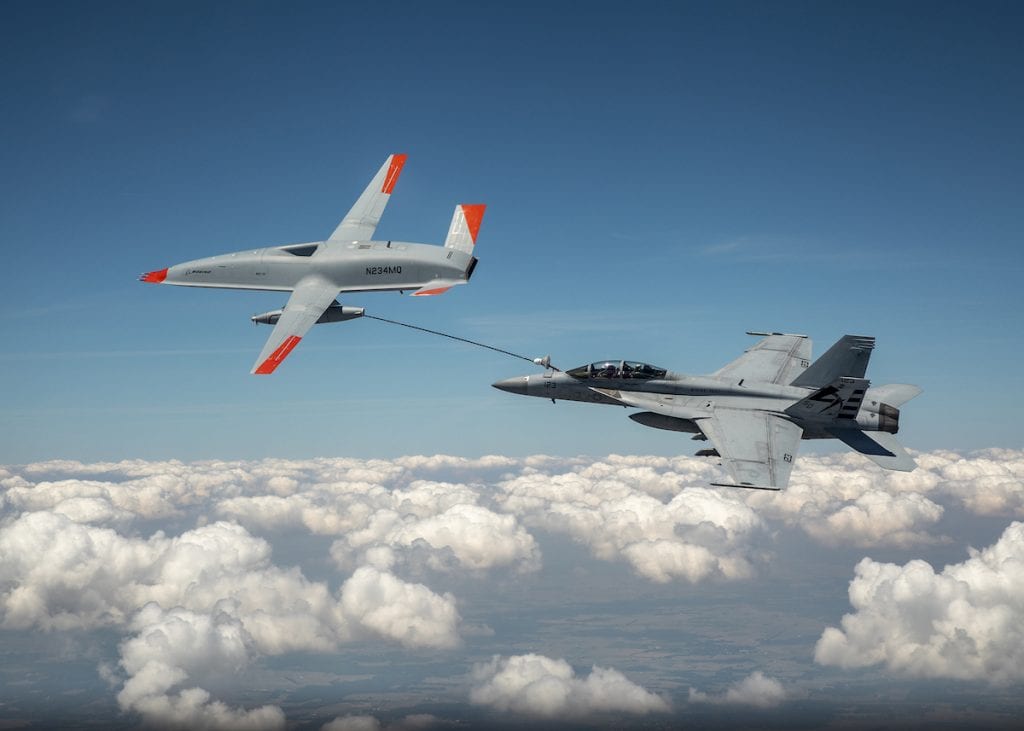
The Boeing MQ-25 T1 test asset transfers fuel to a U.S. Navy F/A-18 Super Hornet on June 4, marking the first time in history that an unmanned aircraft has refueled another aircraft. The MQ-25 Stingray will assume the carrier-based tanking role currently performed by F/A-18s, allowing for better use of the combat strike fighters and helping extend the range of the carrier air wing. (Photo: Kevin Flynn)
The Navy and Boeing have pushed back the initial flight test of the first MQ-25A Stingray aircraft carrier-based tanker aircraft into early 2026.
The government-industry team insisted they are making progress towards the first flight and over the last several months “the team has completed MQ-25A Stingray structural testing on a static aircraft, conducted initial engine runs, completed its flight-certified software, and commanded the vehicle from the Unmanned Carrier Aviation Mission Control System (UMCS),” Rear Adm. Tony Rossi, program executive officer for unmanned aviation and strike weapons, told sister publication Defense Daily in a statement.
A Boeing spokesperson added that the first MQ-25 is currently in the last stages of ground testing, is preparing for taxi test, flight software is in place, has completed initial engine runs and is receiving commands from the UMCS.
The company said it and the Navy are “taking additional time to complete deliberate systems level testing and review and approve the final airworthiness artifacts needed for a flight clearance.”
Once that certification is finished, the team will fly when weather permits.
Rossi also confirmed that Navy leadership recently signed the Milestone C Test and Evaluation Plan (TEMP) and that low-rate initial production is planned for 2026.
In 2024, a Navy official indicated the first flight would occur at Naval Air Station Patuxent River, Md., in spring 2025 before reaching initial operational capability in 2026 upon completing carrier integration.
In early 2025 the Navy’s “Air Boss” claimed the MQ-25 would still fly before the year is out, despite previous delays.
“We will fly MQ-25 in ‘25. You can quote me on that, we will fly that platform in ‘25 and get that thing on the carrier in ‘26 and start integrating that thing. That unlocks the future of manned-unmanned teaming, which is number two in the NAVPLAN for [former Chief of Naval Operations] Adm. Franchetti,” Vice Adm. Daniel Cheever, commander of Naval Air Forces and Naval Air Force – U.S. Pacific Fleet, said at the time.
However, in April then-commander of Naval Air Systems Vice Adm. Carl Chebi warned there was still a lot of work necessary to push MQ-25 to have its test flight this year.
He said the balance entailed “tough discussions” on if the team can identify barriers to first flight and raise them to appropriate leadership levels so they could change the development timeline and move some pieces later to enable the 2025 fight timeline.
Chebi argued those decisions were happening at too low of a level and “we have too many folks saying no who don’t have the authority to say yes.”
In August, Cheever reiterated the plan for MQ-25 was still to conduct its first test flight this year and perform carrier integration in 2026.
The Navy first awarded Boeing an $805 million engineering and manufacturing development (EMD) contract in 2018 to design, develop, build, test and verify the first four MQ-25s.
The Navy program plans to produce 76 MQ-25s, including four EMD models and five system demonstration test articles, to replace F/A-18E/F Super Hornets currently performing tanking duties in order to free them up for strike and training missions. The upcoming test will be with an EMD model.
The MQ-25 previously dealt with a round of schedule delays caused by maturity issues and the need for additional testing before moving to production, according to a 2023 DoD Inspector General Office report.
A version of this story originally appeared in affiliate publication Defense Daily.